Seabird Sunday ID CHALLENGE – 2 August 2020 – Advanced by Karen Dick
This seabird is large within its group and was seen around the boat on a July pelagic trip from Eaglehawk Neck in Tasmania, beyond the Continental Shelf. They tend not to settle on the water but will make repeated passes around the boat.
This species has had its two subspecies split into separate species under IOC nomenclature, so see if you can work out which particular form this bird is.
Solution:
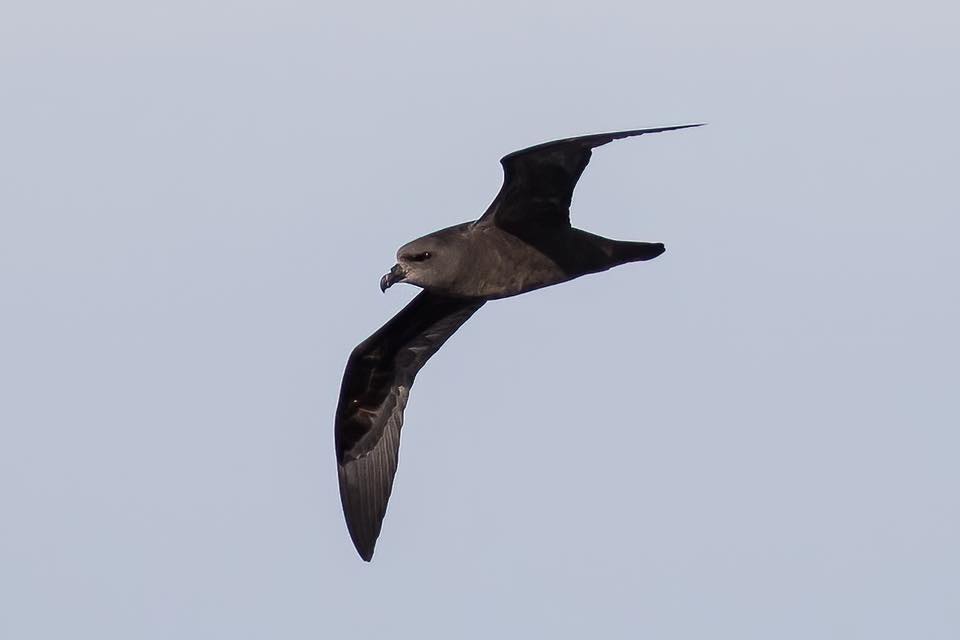
Well done for your work on this bird. This is an all-brown tubenose seabird with a shortish, chunky bill, so takes us to the large, all-dark Pterodroma petrels. It cannot be a White-Chinned Petrel because they have a bone-coloured bill, whereas this bird has a black bill. Sonja Ross nailed it with most of her evaluation.
‘It’s either a Great-winged Petrel (GWPE) or a Grey-faced Petrel (GFPE), with the main things to look for being the depth of the bill and the amount of lightness of the face, with the Grey-faced Petrel being more robust”. This bird has a fairly robust bill, but within the range for Great-winged Petrel. It also shows a typically boxy head, which would look more tapered in Grey-faced Petrel and no significant contrast between the hood and back. It looks to be quite slight in build. The bird also shows a pale chin and limited paleness on the face, although this is a highly variable trait and can show some overlap with Grey-faced Petrel. The structural features are an easier way of differentiating between the two species. So this species is a Great-winged Petrel (Pterodroma macroptera). The two species were traditionally lumped as Great-winged Petrel, with the Great-winged Petrel being the nominate subspecies macroptera, and Grey-faced Petrel being subspecies gouldi.
The two species breed at slightly different times, with Great-winged Petrel breeding from late May-Nov in the South Atlantic and Southern Indian Ocean and Grey-faced Petrel breeding from late Jun-Jan, mainly in New Zealand. They moult at slightly different times as well, with Great-winged Petrel moulting their body feathers on the breeding grounds in May, followed by their wing moult between August and March. For Grey-faced Petrel, body feathers are moulted in June/July and wing moult is from Oct-April.
See pics of this bird from Australia here: https://ebird.org/media/catalog?taxonCode=grwpet3&mediaType=p®ion=Australia%20(AU)®ionCode=AU&q=Great-winged%20Petrel
and compare to Grey-faced Petrel here: https://ebird.org/media/catalog?taxonCode=grwpet2&mediaType=p®ion=Australia%20(AU)®ionCode=AU&q=Grey-faced%20Petrel%20-%20Pterodroma%20gouldi

