ID CHALLENGE 31 July L Plate by Janine Duffy
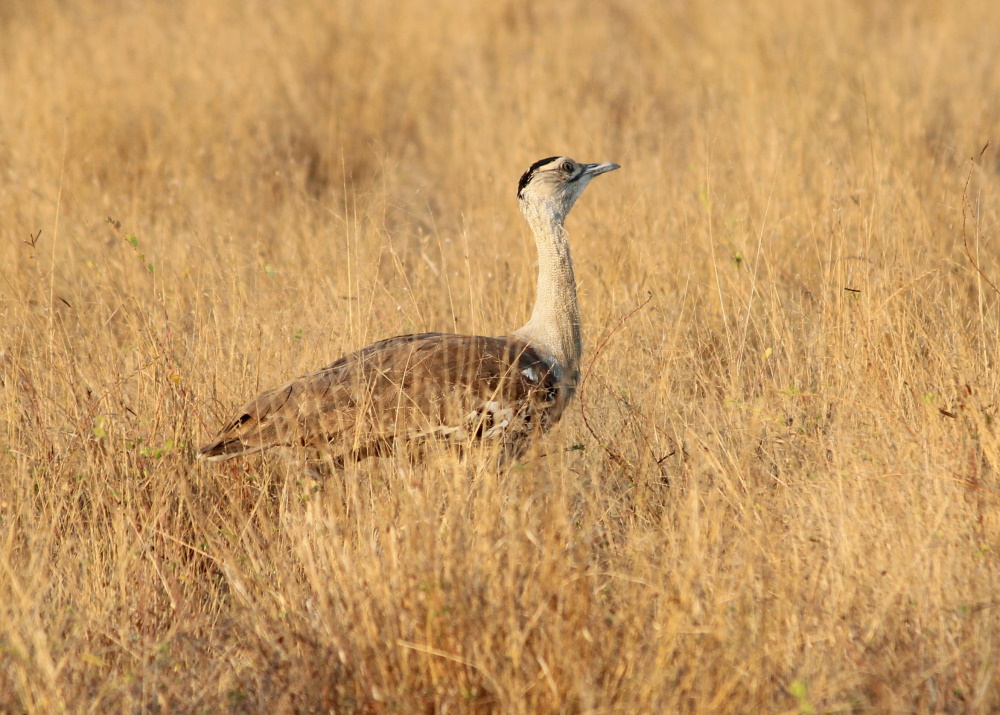
Who is this spectacular bird? Seen at Opium Creek Station, near Point Stuart Wilderness Lodge, on the floodplain of the Mary River, Northern Territory in July.
Size: large Behaviour: walking around in open grassland. Did not fly while we watched.
I’ve put this as an L Plate as, even if you’ve never seen one, you will figure it out if you have a comprehensive field guide. If you don’t it might be harder, as they are not well known by the general public.
I’d love if you could tell me whether you think it’s male or female!
Solution:
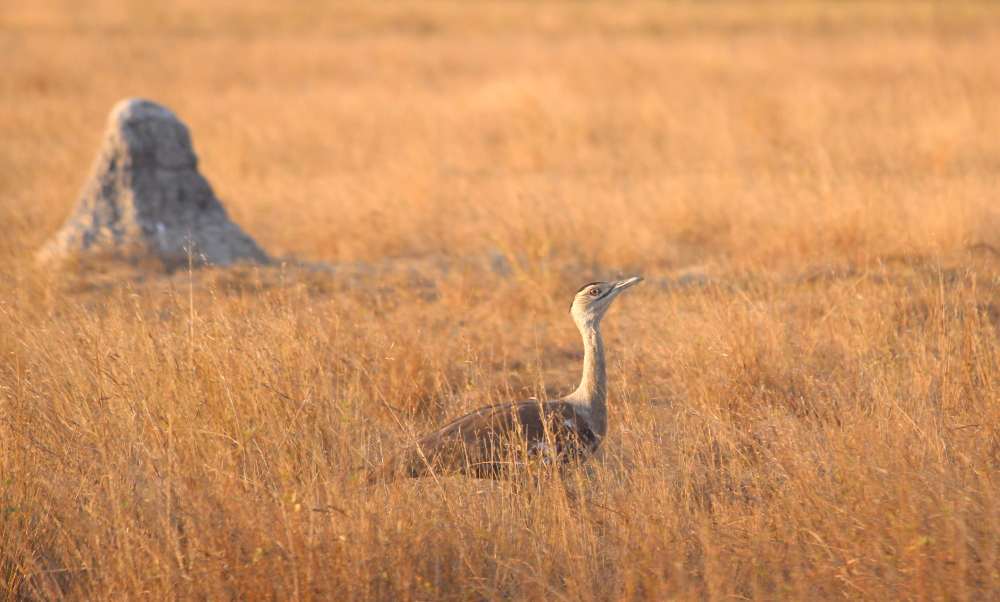
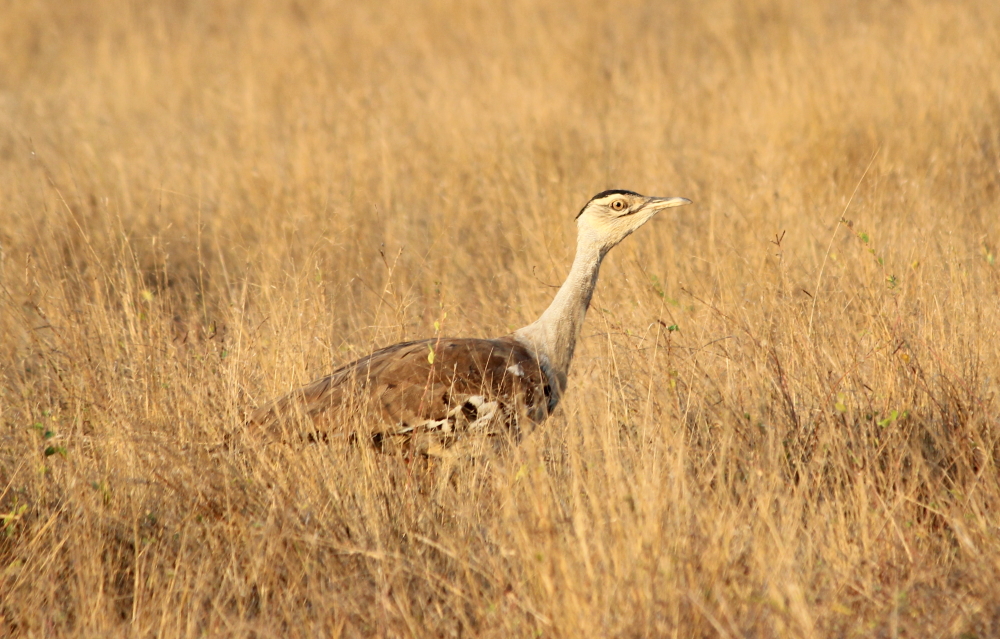
Australian Bustard Ardeotis australis.
Well done everyone, but I’m not surprised. You’re a wily bunch.
But there are a lot of Aussies who don’t know what this bird is, and have never seen one, which is sad, considering that they once ranged the grasslands from Melbourne to Mareeba, Noosa to Ningaloo.
Being a grassland bird, large and reluctant to fly, they were preyed upon by colonists. I’ve read reports of bustard served up for Christmas dinner in early Melbourne. And with the rapid change and destruction of our delicate grasslands for sheep and cattle farming, they quickly declined near the settled areas.
But I digress – how about the sex? I’ve never had trouble telling them apart at Serendip, near Melbourne, where they are bred in captivity. But in the Top End, where this bird was seen, I’ve developed a difficulty.
The main difference is/can be size. Males 4-7kg, females 2-4kg. In your own local area you get used to the sizes of your local birds, and at home in Melbourne (Serendip) the male bustards are huge.
But in the Top End, I feel that the male bustards are smaller. This often happens when you travel right across the country. They conform to Bergmann’s Rule: birds in warmer areas are smaller than those in colder areas. It threw me. I found myself without a clue.
Both sexes have black crowns. Both sexes have a black chest band. The males should be more strongly-marked. But I had the added complication that bustards in the Top End are also lighter-coloured than their Southern cousins.
So in truth, I can’t really be sure. I’m happy to go with Karen & Betty that this is a male. I would welcome more details from you northerners!!!
Learn more: https://www.birdlife.org.au/bird-profile/australian-bustard
Comments:
Sue Gadsby Lee: another reason for their decline was feral animals….I think foxes & cats in particular. My Dad owned a sheep & cattle station just east of Charleville SW Qld (my childhood home too) & he saw none during his childhood or early adult….until he & his brother (on another property) shot out the foxes & feral cats….then the Aust Bustards came back & now breed a few hundred mts from the house xo
Caz Bartholomew: I love these special birds which were part of a captive breeding program before Serendip was Serendip. A long time ago but still seen by India etc as useful for their declining bustards. I prepared the research for my friend Don White and put on website for free access.
Karen Dick: As to why I thought it was a male – I expected that it would have had conspicuous black splotches on the back if it were a female. I couldn’t see any, so thought male.
Pamela Keil: I would have said female, but I’m used to the ones around Central Australia, where a male would be more robust looking. Not sure what happens near the Top End if they’re smaller overall…
 Women Birders Australia