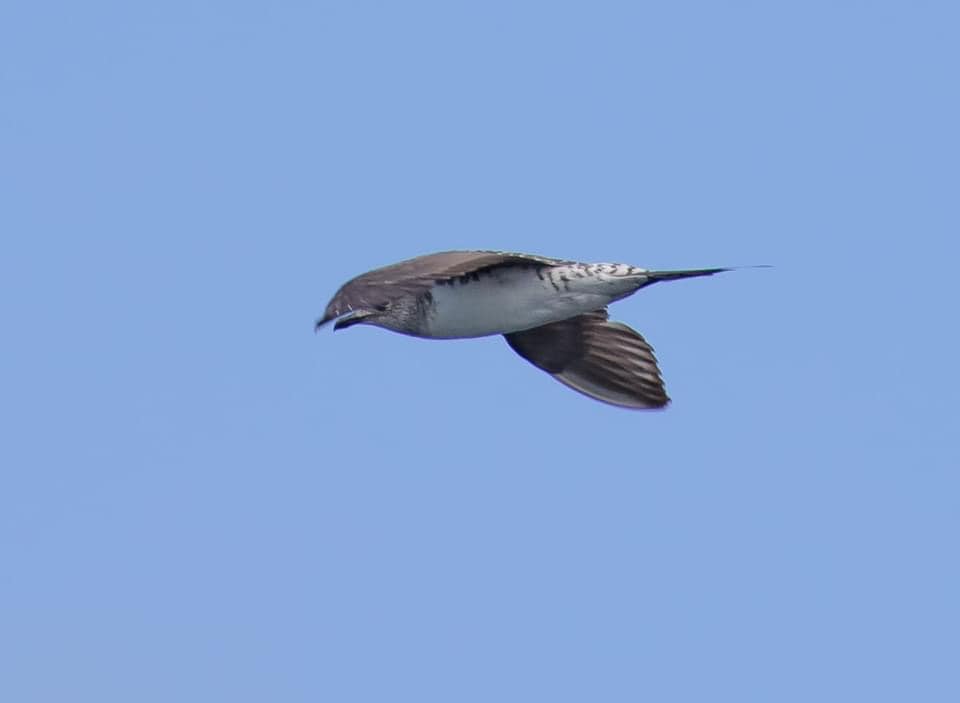
Seabird Sunday ID CHALLENGE 27 December 2020 – Advanced.
This bird was seen off the continental shelf on an Eaglehawk Pelagic in December.
Photograph loaned by Paul Brooks.
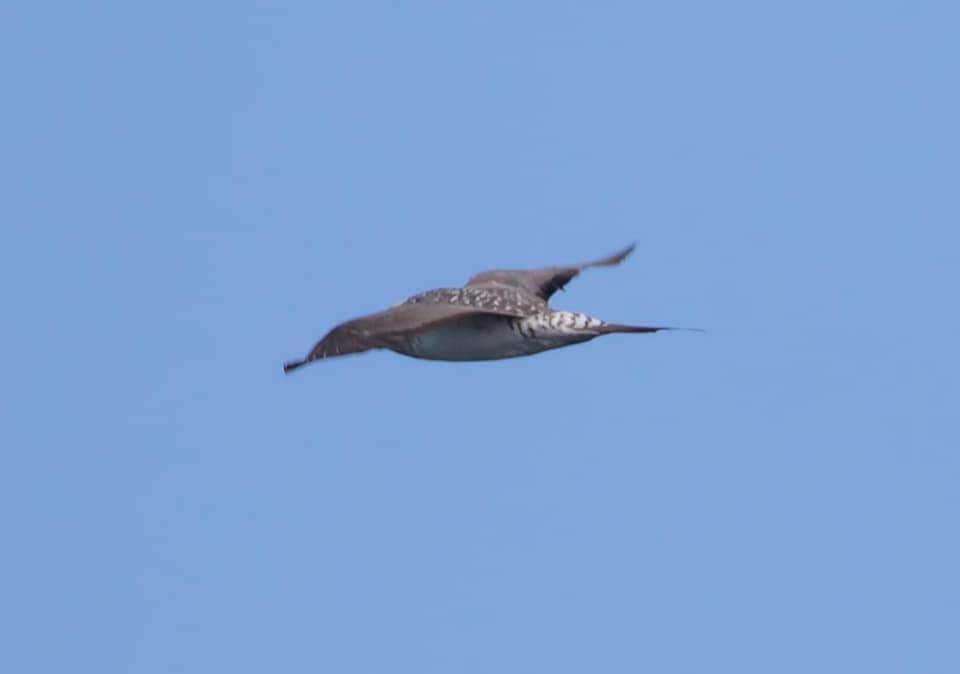
Solution:
Thanks to Paul Brooks for the excellent photos for the challenge.
This is one of those species that would be easily recognisable at sea because of their strong, direct flight and tendency to harass other birds to steal their feed. Lack of a tubenose rules out the petrels and the shape of the bill rules out shearwater. The bird looks superficially like a gull, so we need to look to the jaegers (skuas if you are looking in a European book). These birds are parasitic, obtaining all of their food by theft, from other birds, or by feeding on carrion.
There are three jaegers that can be seen in Tasmanian waters – Parasitic (or Arctic), Pomarine and Long-tailed. There are various plumage forms for all of these, including Pale, Intermediate and Dark morphs. They are not easy to differentiate, and even harder in the field. Photography has significantly improved our ability to differentiate these species.
On the boat, this bird was initially thought to be a Parasitic Jaeger. Pomarine is ruled out on body shape alone, as they are very barrel-chested and chunky looking, whereas this bird looks quite sleek and elegant. There are also plumage differences, but structure is a good differentiator for Poms. So this left us with a choice between Arctic and Long-tailed. Please be aware that the length of tail streamers will not help you much in the Southern Hemisphere as both species have them and it is only in breeding plumage that Long-tailed have much longer streamers. As they breed in the northern hemisphere, we are unlikely to see this feature. Long-tailed jaeger is generally smaller and daintier than Arctic, but that is difficult to determine from a single photo.

So the bird appears quite sleek and delicate, the bill is relatively short and stubby and it has dark secondaries (the inside flight feathers) creating a dark trailing edge. In addition, it has a big gonys (see below) on both lower and upper mandible as a percentage of bill length. There is no white spot on the forehead at the base of the bill, the bands on the rump are very regular and it has a clean unmarked undertail.
So these features together are good features for Long-tailed Jaeger Stercorarius longicaudus There is little barring in the underwing so it is a non-breeding adult, or close to it. This is supported by it being in primary moult in November, when it was seen.
In the second pic, you can see the white shafts in the outer primary feathers. The average number differs among the three species of jaeger (typically … Long-tailed has the least, Parasitic more and Pomarine the most). It is a bit variable in individuals, so not always an ideal field mark.
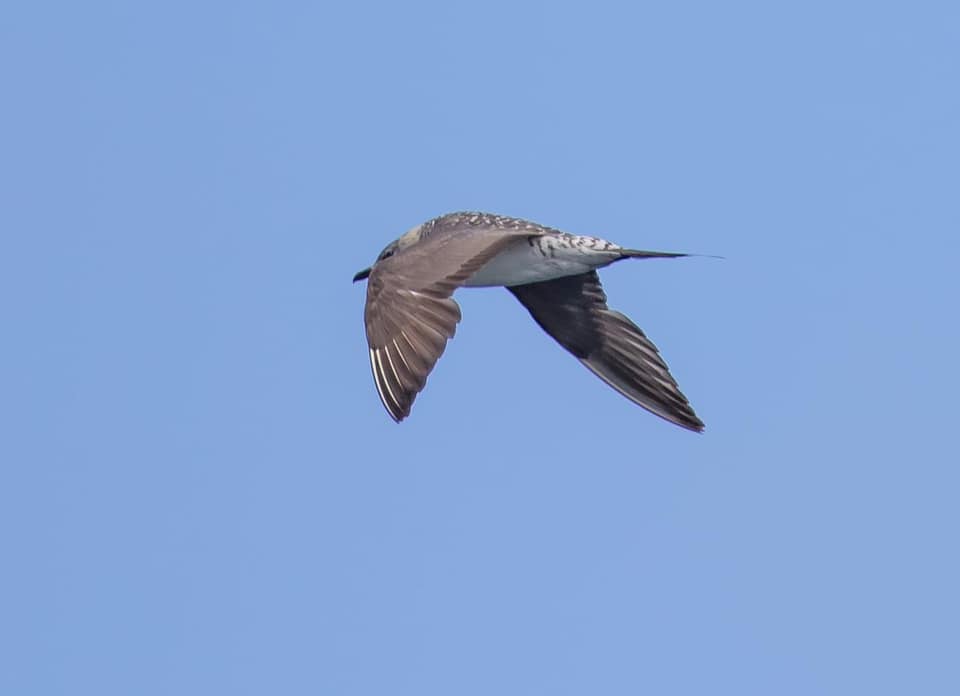
So well done everyone that got an ID for this bird. They don’t always look like the ones in the Guidebooks and don’t always have tail streamers, so you can expect to be flummoxed by a jaeger at some point in the future, if you spend time at sea!
Gonys: From the Greek gonios for angle and genys for jaw. This term is very misunderstood and often used incorrectly. The gonys is the ridge on the lower mandible from the tip to where the two sides of the jaw (rami) branch. The gonydeal angle or angle of the gonys is the point where the bill turns upwards near the tip. The gonydeal angle is pronounced in many large gulls.
eBird: https://ebird.org/species/lotjae?siteLanguage=en_AU
Conservation status: Migratory Species EPBC/Least Concern IUCN Red List
More information: https://www.birdlife.org.au/afo/index.php/afo/article/view/835
 Women Birders Australia