ID CHALLENGE Friday 25 September L Plate by Janine Duffy
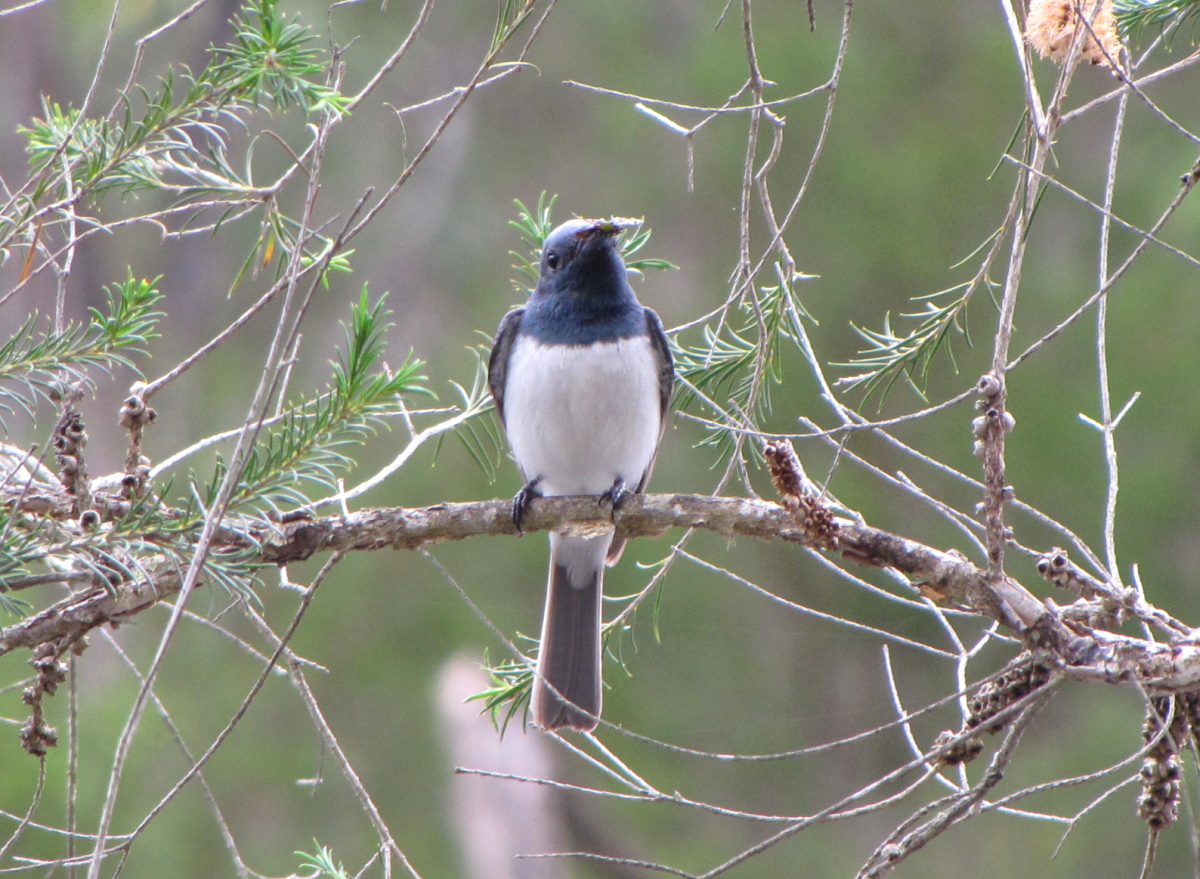
Who is this little cutie? Seen at Double Creek, Mallacoota VIC in January.
Size: small. Behaviour: Flying about in the middle canopy of near-coastal paperbark forest.
It’s a bit borderline as an L plate challenge (a little bit hard), but I think you can get it.
Solution:
Leaden Flycatcher Myiagra rubecula
Isn’t he just a darling? He was carrying a petal to his lady. The pair were in the process of building a nest on the branch of a big Giant Honey-myrtle – it was almost complete but nearly invisible, decorated with lichen and, I think, snooked into a natural depression on the branch so it barely showed above the edge.
Everyone got this, even though flycatchers can be hard. His lead grey plumage is a helpful pointer when you can see it, as you can in this pic. But in poor light it can look black. And then telling him apart from a Satin can be tough.
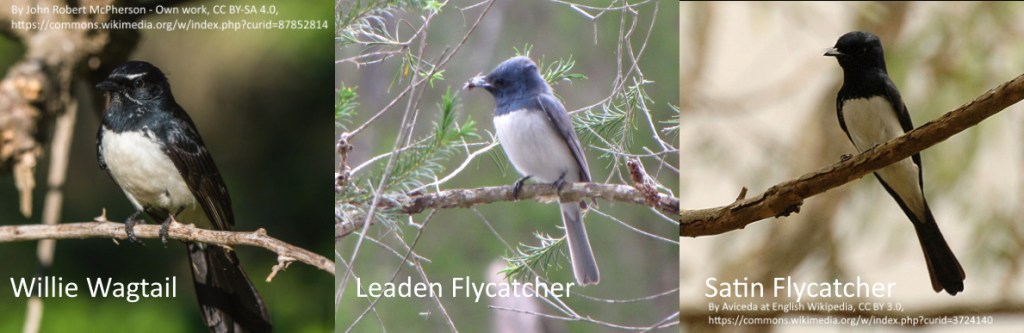
The thing to look for is the angle where the dark breast meets the white at the wing. If it’s straight across (90° to the wing) it’s a Leaden. If it’s curved down, it’s a Satin. Also the underside of the tail – pale grey brown in Leaden, black in Satin. Male Satins never have pale edging to their wing coverts and tertials, but Leadens do when their plumage is fresh.
Interesting fact: Leaden Flycatcher are migratory in the south (Vic) arriving in October leaving in March. Satins stay down here all year.
https://ebird.org/species/leafly2/
I’m attaching a pic showing a comparison with Satin Flycatcher (male) and Willie Wagtail, just for interest. Willie Wagtail always had some white on the eyebrow and malar (lower cheek) area, and a much broader tail.
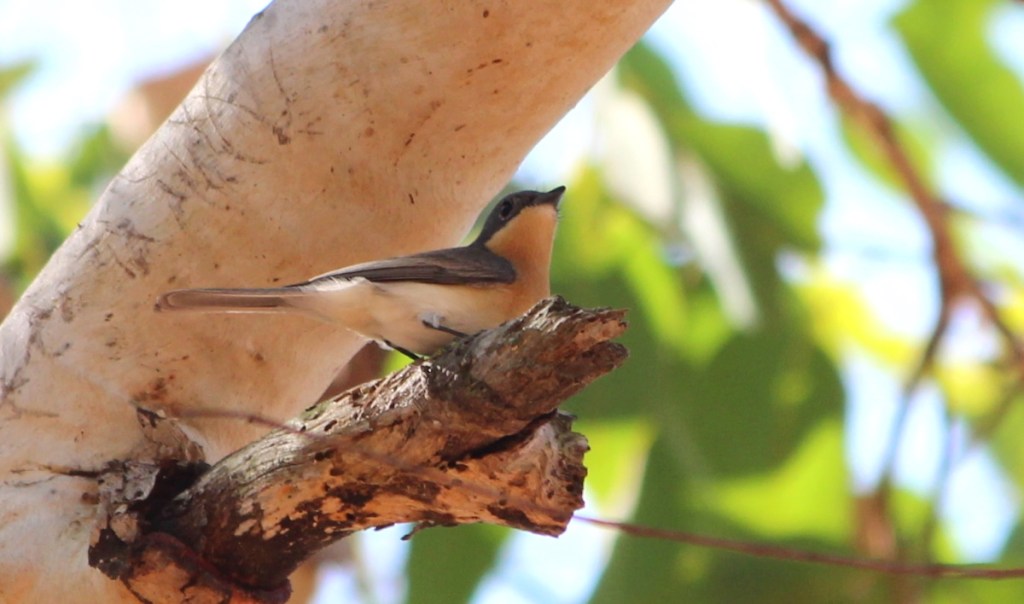
And here’s a pic of a Leaden Flycatcher female, but from the Northern Territory Top End.
 Women Birders Australia