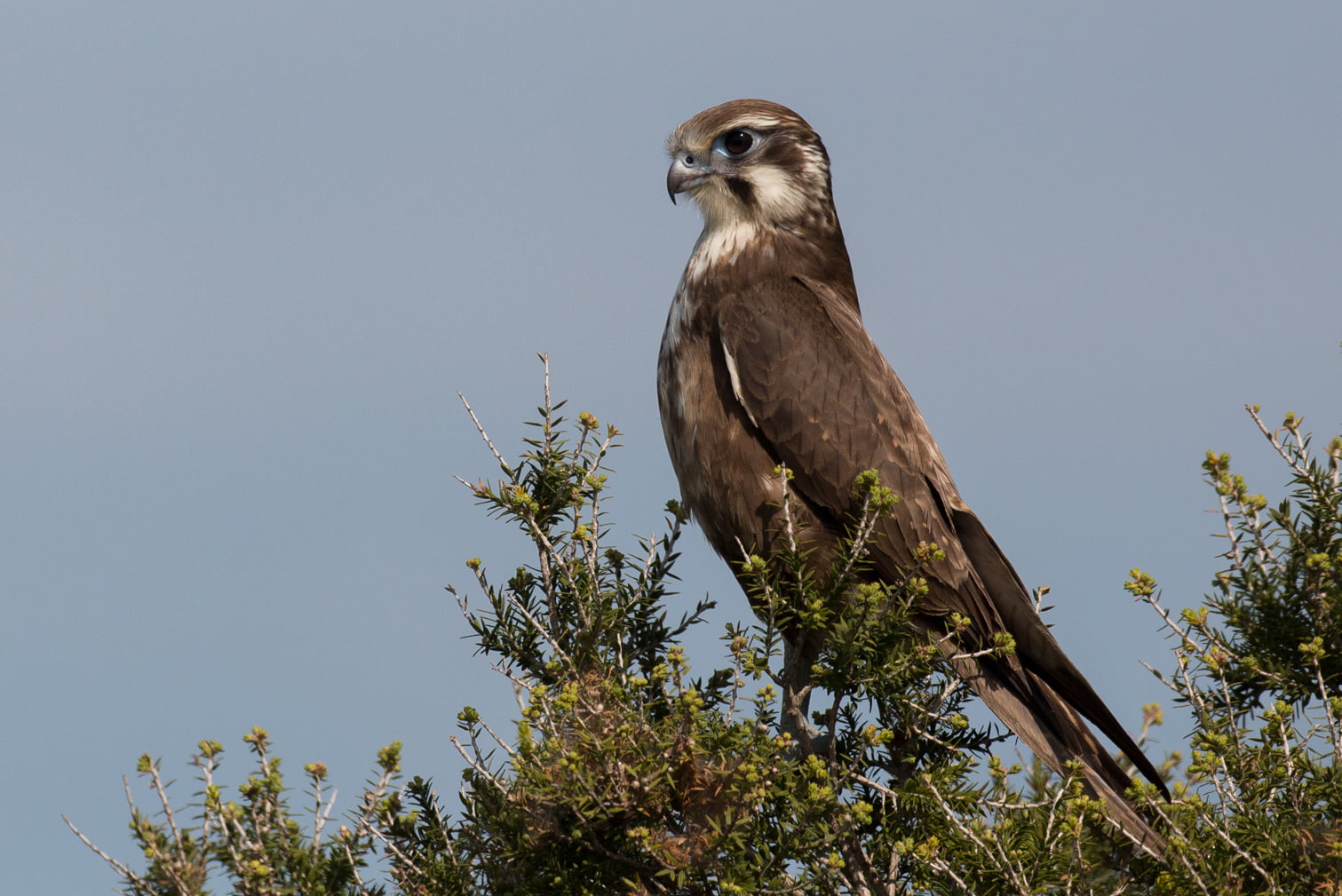
ID Challenge, September 22, 2020 L plate by Sonja Ross
I photographed this bird at the Western Treatment Plant, Werribee, near Melbourne, but they can be seen over the entire country. There is some variation in plumage colour but generally they are distinctive and fairly easy to identify.
Solution:
As you have said this is a Brown Falcon Falco berigora, one of our common raptors.
The two “tear drops” as mentioned by Penelope are a give-away if you can see the face.
They have short “trousers” i.e. the legs are feathered on the top section. As you can see in the wing of the bird in flight, there is strong barring visible, and this can also be seen if you are looking up at the underside of a bird in flight.
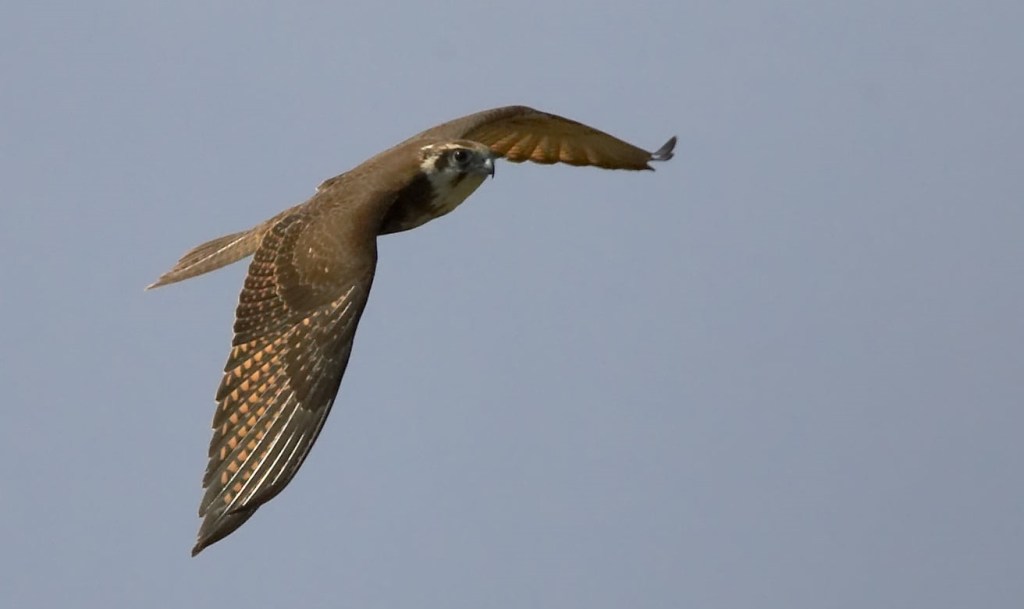
When it is windy, Brown Falcons can almost hover, but clumsily, unlike Nankeen Kestrels or Black-shouldered Kites which are more proficient at hovering.
They have a brown back but the breast varies from pale with streaks to quite brown. There is discussion still about the variation in plumage, which does vary, quite a lot, but I found an article by Paul G. McDonald from the Emu, 2003,. I’ve copied the Abstract underneath.
This is the link is case anyone is keen to read more: https://www.une.edu.au/…/0015/23028/mcdonald-2003a-emu.pdf.
Abstract.
“The Brown Falcon, Falco berigora, is one of Australasia’s most common raptors, yet considerable confusion remains over the influence of geography, age and sex on plumage and bare part colouration in this species. To address this issue, 160 immature and adult falcons from an individually marked, closely monitored population were examined. In contrast to previous studies, all were of known sex, age-group and part of the resident population or their offspring. Adult males had significantly lighter upperpart, cap, ventral and underwing covert plumage in comparison with other birds, closely resembling what has previously been described as a ‘rufous morph’. Immature females were significantly darker than other ages and sexes in upperpart and underwing covert plumage, resembling descriptions of ‘dark morphs’. In contrast, plumage of immature males and adult females tended to be similar and intermediate between these extremes, resembling the ‘brown morph’. The buff-tinged, not white, ventral plumage and darker underwing covert plumage of immature males separated them from adult females. Cere and orbital ring colour also differed with sex and age: immature females had the dullest facial bare parts and adult males the brightest, adult females and immature males again being intermediate between the two. The results indicate that most variation in plumage and facial bare part colouration observed in the population could be attributed to age and sex differences as opposed to racial clines or the existence of colour morphs. Moreover, the brighter colours of adult falcons may function as honest signals of quality.”
Conservation status: considered secure, but population decreasing
http://birdlife.org.au/bird-profile/Brown-Falcon
 Women Birders Australia