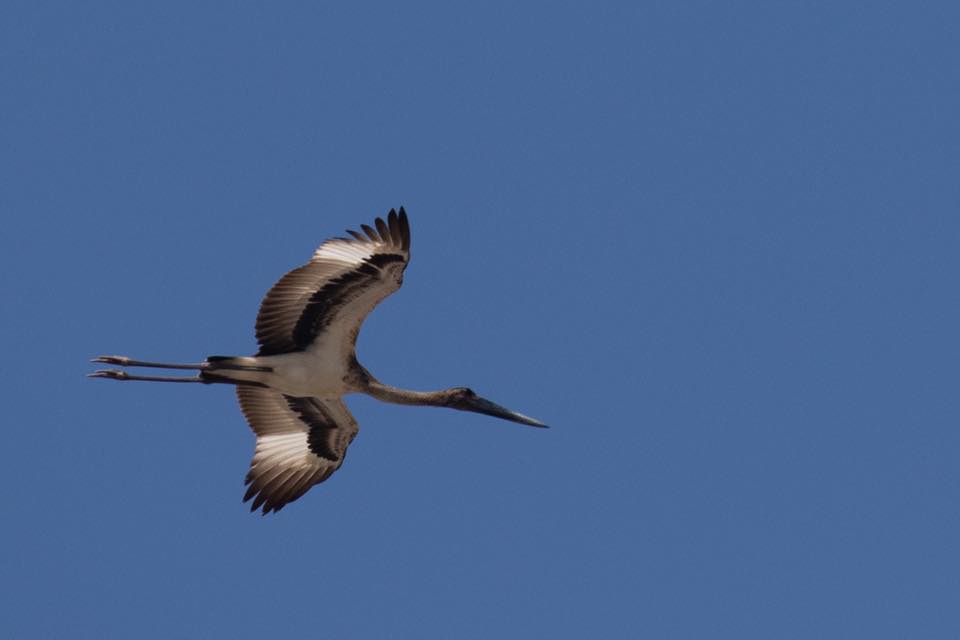
WADER WEDNESDAY ID CHALLENGE 23 September 2020 – Kindy by Karen Dick
Size – you wouldn’t miss it!
Behaviour- wades around in shallow water, or wanders around on grassland.
Solution:
This bird has very long trailing legs and a very long neck, as well as a huge, chunky bill. The sheer size of the bird narrows down our choices considerably to the Cranes and Storks. The size of the bill and the colouration of the bird rule out the cranes, which are grey in all age plumages with more streamlined bills.
This leaves us with the storks, of which there is only one resident member in Australia. The only other vagrant member of the stork family seen in Australia is the Greater Flamingo, which has a different bill shape and pink wings. So this leaves us with only one option – Black-necked Stork (Ephippiorhynchus asiaticus). This particular bird has brownish legs and neck, and dark outer primary and secondary flight feathers, which makes it an immature bird. As an adult it will have striking red legs and beautiful white wings with a broad iridescent black stripe through them. In adults, males and females can be told apart by the colour of the eye – yellow in females and dark in males.
These birds are generally confined to the northern half of Australia in the tropics and subtropics and favour freshwater wetlands and associated grasslands.
Old timers often call this bird a Jabiru, but this is in fact not correct. Jabiru is a stork of South America, predominantly in the pantanal of Brazil and in Uruguay. The word means “swollen neck’.
If you look at the pictures here of the Jabiru Jabiru mycteria you’ll see what they mean! https://ebird.org/species/jabiru
 Women Birders Australia