ID CHALLENGE Monday 14 September L Plate by Janine Duffy
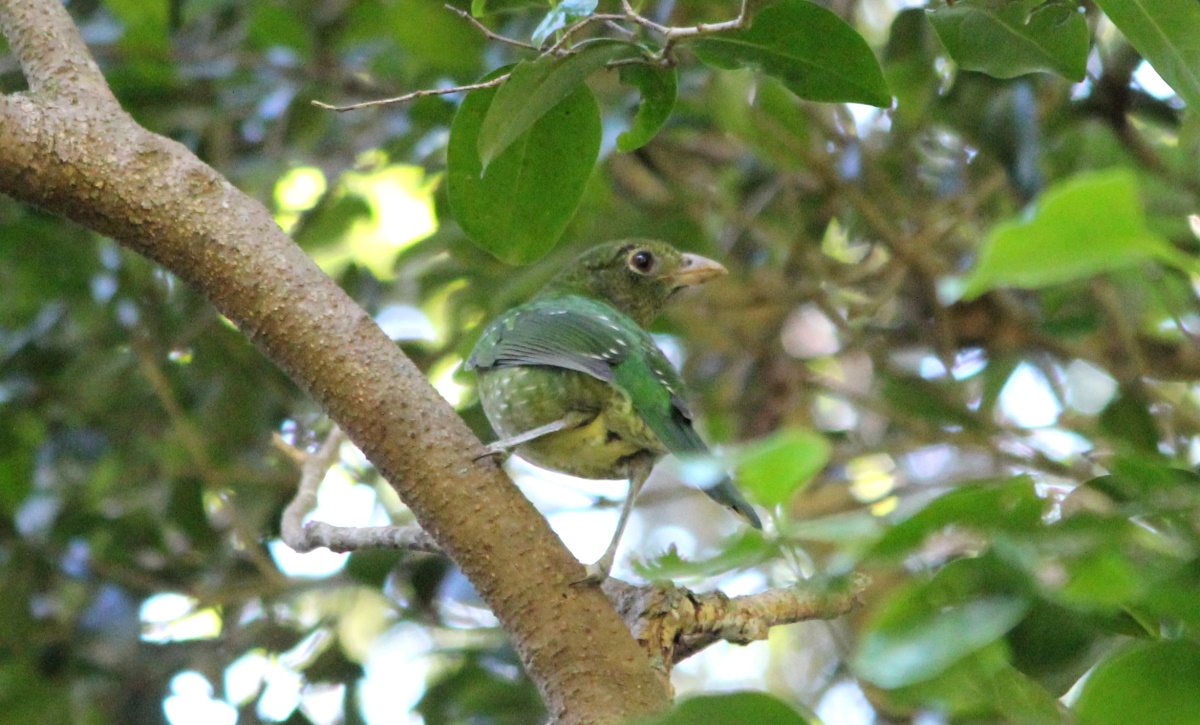
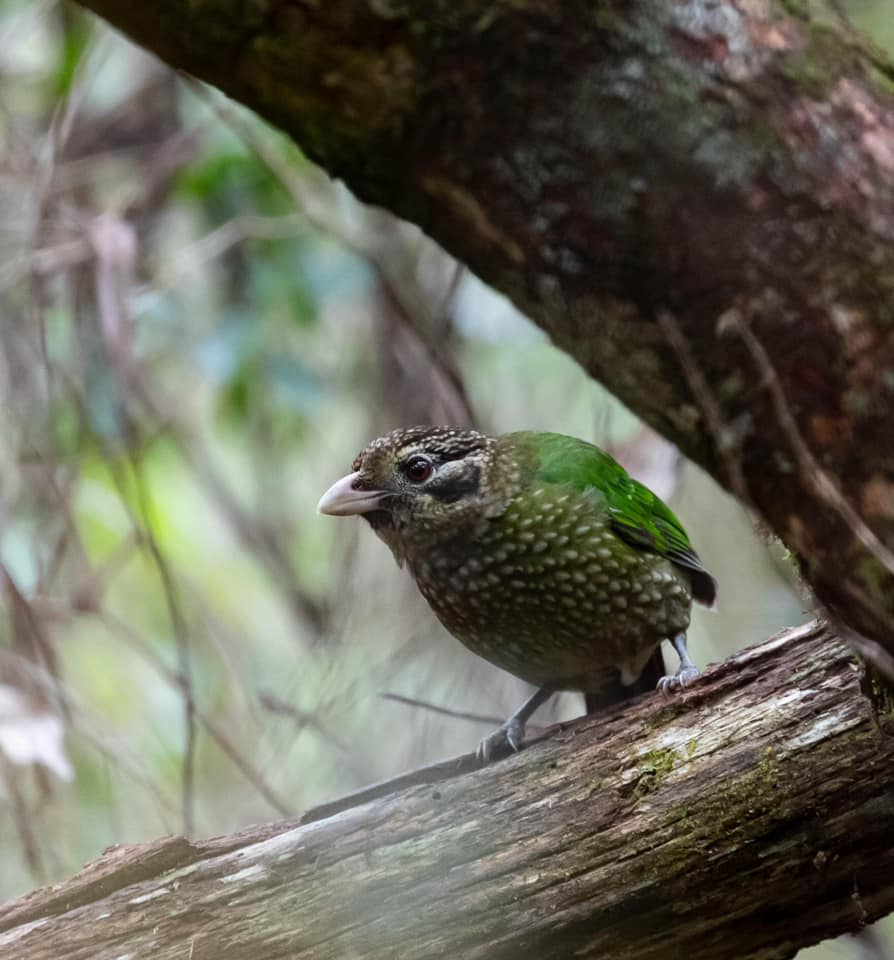
Who is this charming bird? Seen at Binna Burra – Lamington NP, southern QLD in May.
Size: medium, quite chunky. Behaviour: flying around in canopy of rainforest trees.
Solution:
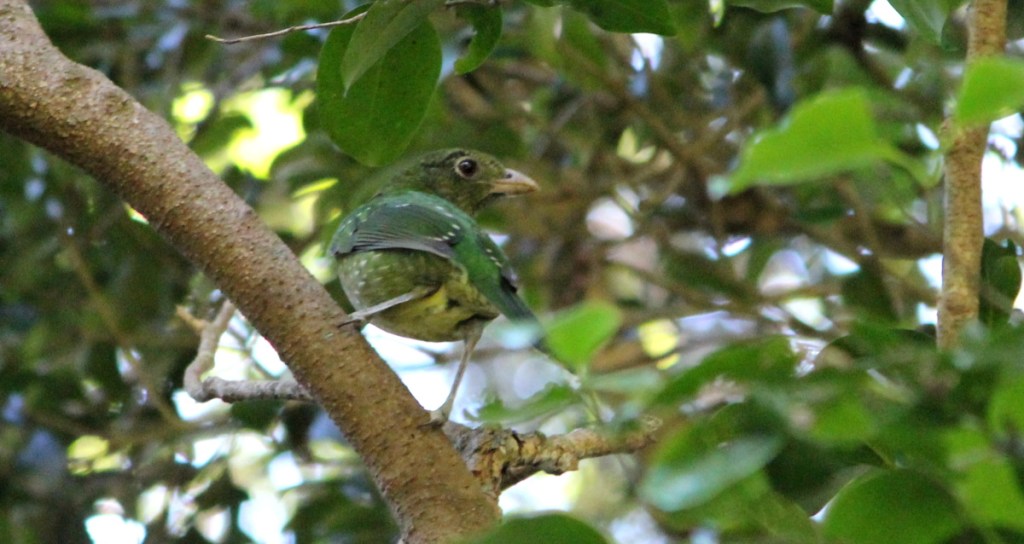
Green Catbird Ailuroedus crassirostris
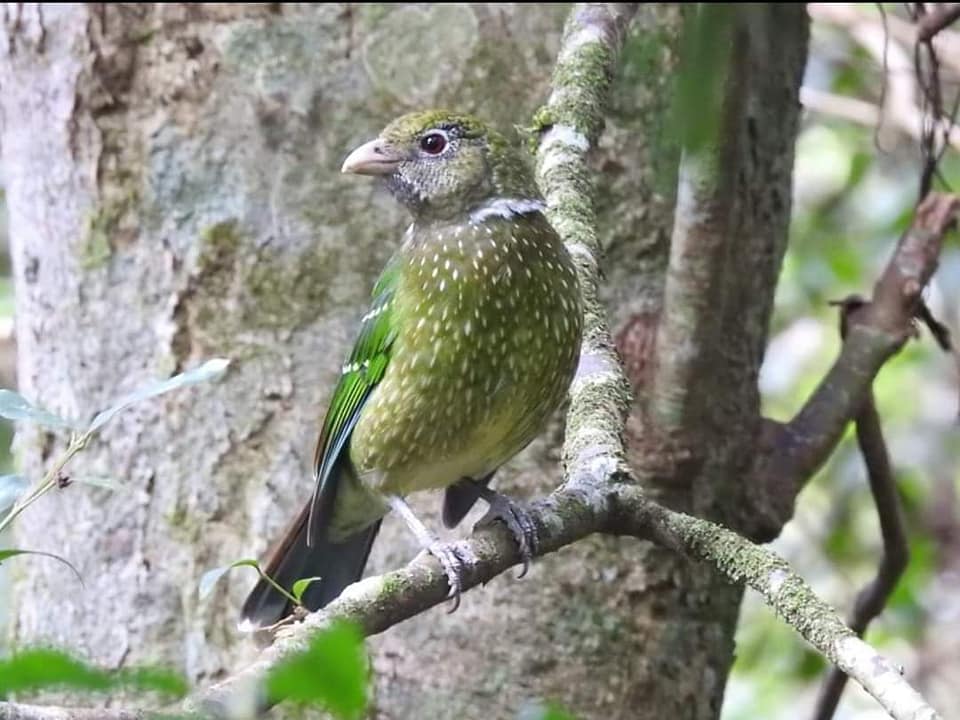
I’ve included Annette Clancy‘s lovely pic (above) in the solution, with permission. From Annette: “This photo was taken in Dorrigo National Park. It was one of my first ever bird photos, and searching to find out what is was influenced me in deciding to start birdwatching.”
Looking at this, it makes me wonder why so few birds are this rich green? Parrots are of course, but not so many passerines. Many have a bit of green on them, and many are olive or greenish yellow, but this all-over bright green is pretty unusual, even in rainforest birds.
The dark eye & pale apricot bill shows that this bird is an adult. Juveniles have a lighter eye and grey bill.
Finding this bird in the ABG was a bit of a challenge. The picture index at the front (which I’ve gotten used to) only has a very brown bowerbird.
Catbirds are a type of bowerbird, but you wouldn’t necessarily know that from a first glance. Like other bowerbirds, they are chunky, with a strong beak. They have a shortish tail and powerful legs. (There are exceptions though: Golden & Regent Bowerbirds have longer fine bills and fairly long tails).
They don’t build a bower, and ABG says they don’t clear a display court like the Tooth-billed Bowerbird either. Another source said they do clear a court, but maybe that info has been superceded. (Issue resolved: see Sally Sheldon’s comment below)
There are 10 species, throughout Australia & New Guinea. We have two/three – the Green, Spotted & due to a recent split, the Black-eared, formerly a ssp of Spotted. Black-eared only occurs in Australia in a small area of far north Qld around Iron Range.
See all the catbird species here starting with White-eared Catbird (at the top right you can go to the next species.. Ochre-breasted Catbird, and so on and so on) https://ebird.org/species/whecat1
Check out Mary’s & Rebecca’s pics below of a Spotted Bowerbird.
Comments:
Mary Clarke:
Janine Duffy This would be a Spotted Catbird – photographed in Little Mulgrave Valley, south-west of Cairns.
Rebecca Connor:
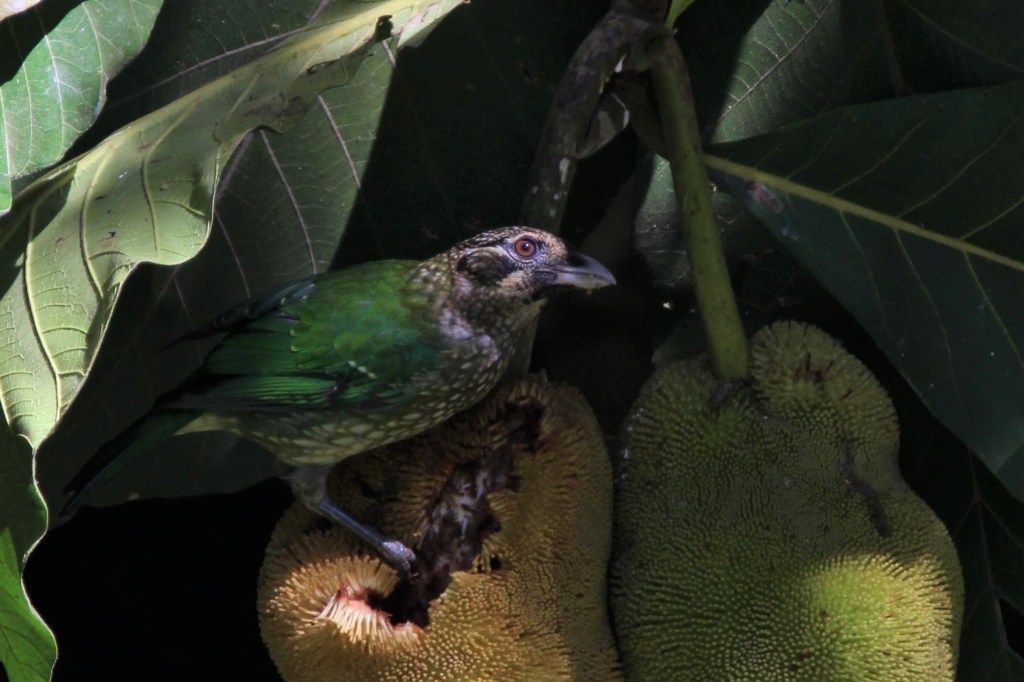
Mary Clarke Great shot! Did you have to climb a tree? 😉 I still haven’t been able to get a decent photo of a Spotted Catbird. This photo was taken at Mount Hypipamee.
Mary Clarke:
Nooo! Even though i hear them almost daily, I rarely get an opportunity for a good shot. It was eating fruit from our Marang tree – I don’t like the fruit so I didn’t care – especially since it gave me the opportunity for a photo.
Sally Sheldon:
Ok, so a treasure-trove distilled to a drop:
“The Catbird species alone amongst the bowerbirds form monogamous pair bonds…. while males don’t assist with nest building, incubation or brooding, they assist with food provisioning to young. They do not clear courts/build bowers. (Makes sense; no need, they are monogamous, not polygynous.) So in these respects, they stand alone amongst bowerbirds. They do, however, share with other (polygynous, court-building bowerbirds) anatomical features including skull, wing, and sperm sructure, as confirmed by genetics…”
Well, that is as per Friths, “Bowerbirds”, in 2008… there may be updates etc to that?
Janine Duffy:
excellent yes makes sense. The other source was Graeme Chapman’s website, which is usually very good but this could just be a rare error.
Sally Sheldon:
yes, I just checked his website and see what you mean… HANZAB states same as Friths (“Do not build bowers or have display courts”). Apparently, for a long time and until relatively recently, Tooth-billed Bowerbird was called Tooth-billed Catbird, so… maybe there was something blurry there that came across into Graeme’s website summaries – it is such a monumental piece of work and, as you say, always so reliable.
 Women Birders Australia