ID CHALLENGE 28 August 2020 L Plate by Janine Duffy
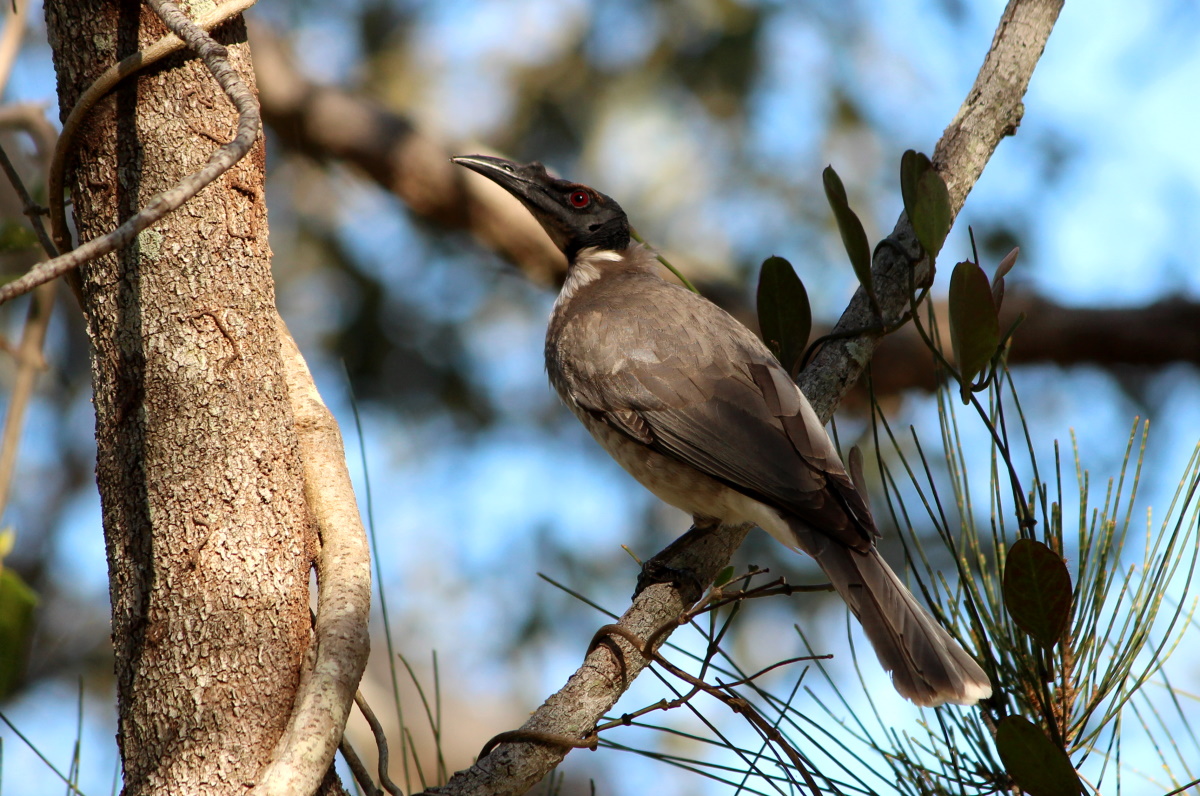
Who is this funny bird? Seen in a park near Lake Weyba at Noosa Queensland in May, with others just like it.
Size: pretty big for this sort of bird. Behaviour: flying around in the canopies of small and large trees.
Solution:
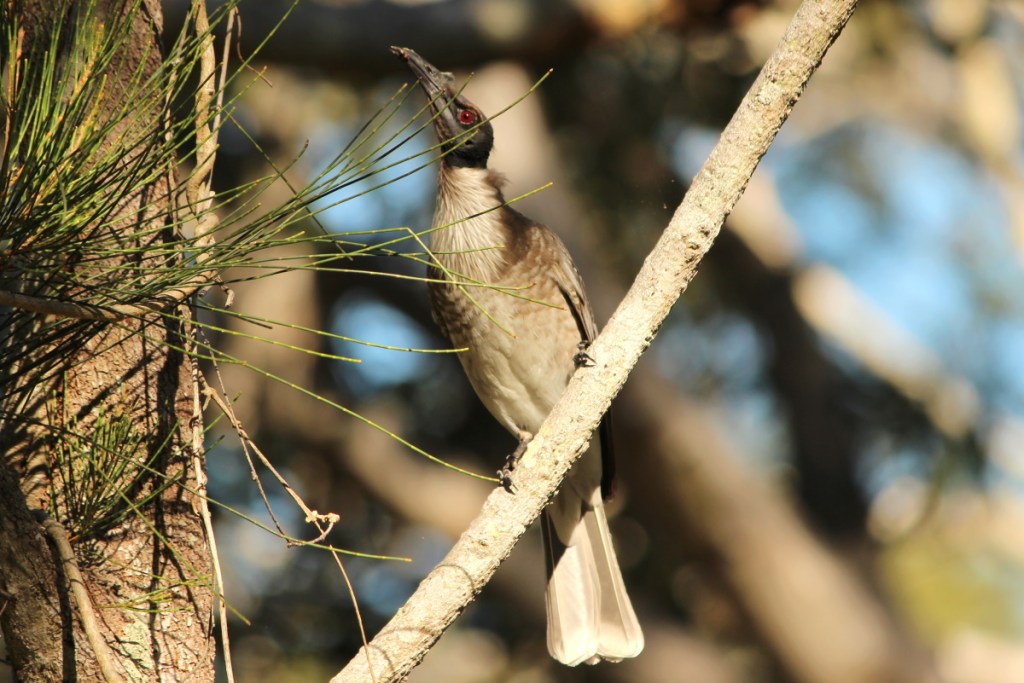
Noisy Friarbird Philemon corniculatus
This spectacular, strange and oddly handsome bird is clearly a member of the friarbird group of honeyeaters. That bare head, with a triangular projection like a little dorsal fin (casque) gives it away.
The location was also helpful – Noosa, just north of Brisbane, is only home to two friarbirds: Noisy and Little. And Little Friarbird is our only friarbird with almost fully-feathered head and no casque.
This bird has a completely bare head, a pronounced casque, a red eye, and plain grey feathers on the back with no pale edging. It’s an adult Noisy Friarbird.
But what is a friarbird?
Friarbirds are a group, genus Philemon, within the honeyeater family Meliphagidae. They are large, often have bare skin on their heads or around their face, and coloured in drab brown, grey and cream.
There are around 15 species in total, spread throughout Australia, New Guinea, Timor L’este, eastern Indonesia and New Caledonia.
Three of our four Aussie species have the most dramatic casques of all the friarbirds: the projection on the top of their beak. No-one seems to know what it is for, or the reason for the bare skin head (if anyone here has more info let me know – all I’ve found online is theories about nectar collection, pollination and sexual selection).
The Little Friarbird is our only one without a casque. But a cautionary note about using casques to identify the others – juveniles and immatures have reduced casques. Only adults have distinctive ones, so look for other features when separating the Helmeted and Silver-crowned.
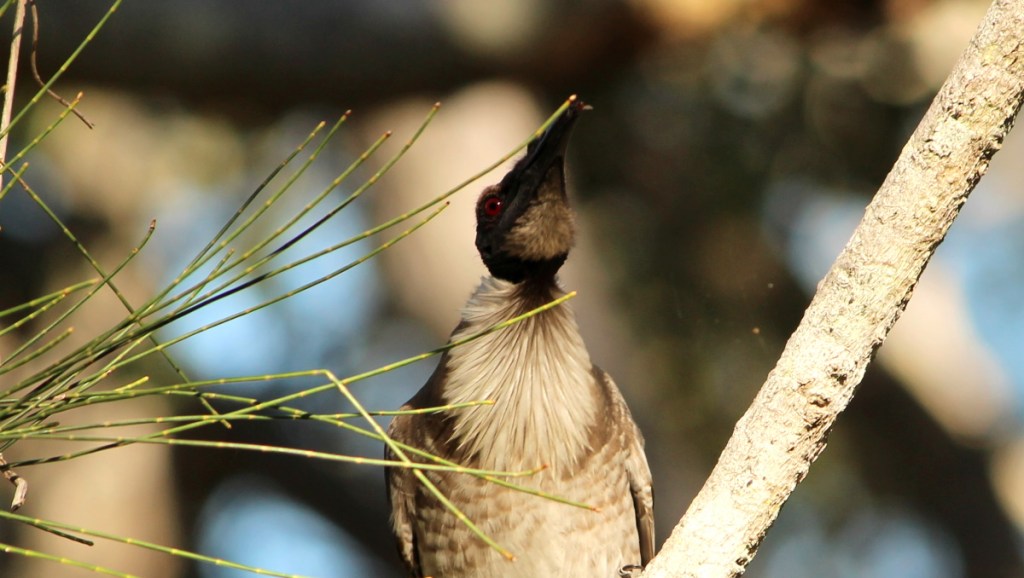
Most friarbirds have a gorget: a neck & breast bib of special feathers. These feathers are lanceolate: shaped like a lance with a pointy end, and often with a darker central vane.
On the Noisy Friarbird the gorget can look very handsome and dashing, like a lacy cravat on a well-dressed, red-eyed vampire.
Check out the gorget on the striking New Caledonian Friarbird!!! https://ebird.org/species/necfri1
And while you’re there, have a giggle at the beak on the White-streaked Friarbird from the Banda Archipelago in Indonesia: https://ebird.org/species/whsfri1/
Of all of the interesting friarbirds in our region, I really think ours are the most debonair.
 Women Birders Australia