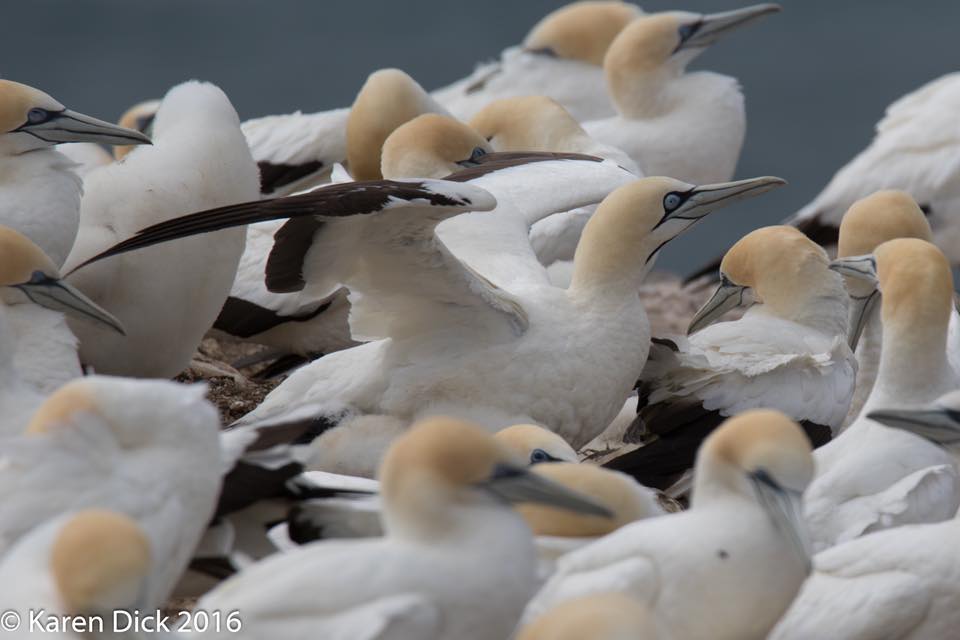
ID CHALLENGE – 9 August 2020 L Plate by Karen Dick
Who are these gorgeous creatures at their nesting colony in Victoria? And as a P Plate challenge, what is special in this picture?
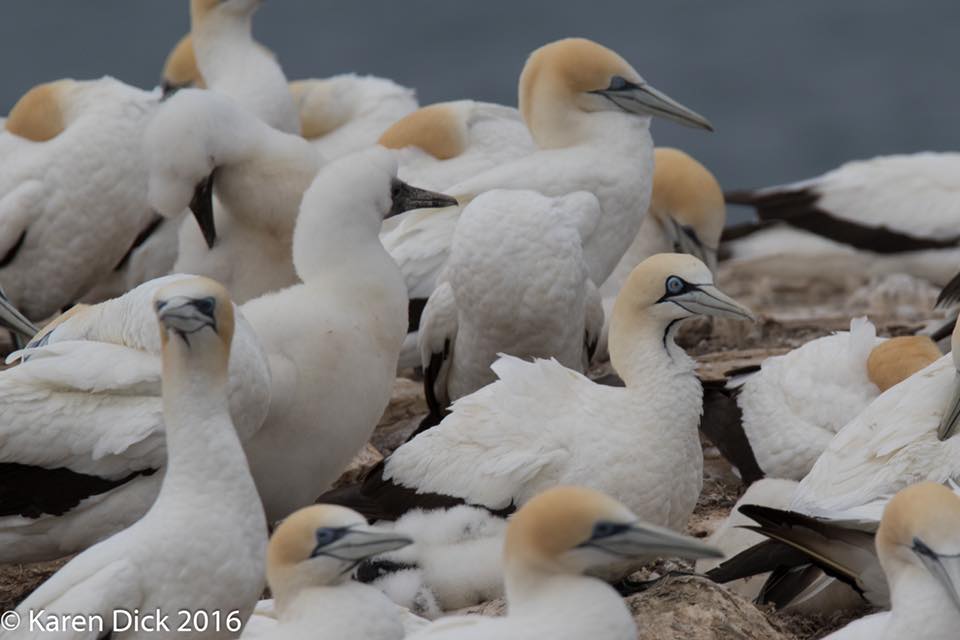
Solution:
As you all correctly worked out, this is a breeding colony of Australian Gannets (Morus serrator) at Cape Portland in Victoria. Australian Gannet is one of three gannet species in the world, the other two being Cape Gannet (Morus capensis) and Northern Gannet (Morus bassanus) which is the only species in the northern hemisphere.
The bit that is special in this picture is the centre bird, which is a Cape Gannet that has been present in this colony of Australian Gannets for several years. The long gular stripe is the giveaway – photo 3 shows the stripe on an Australian Gannet as well as the Cape Gannet. In the Cape Gannet, the gular stripe is longer in males than females, but generally, in all species, males and females are alike. There are other differences between the two species, including the extent of the blue skin around the eye and the extent of black in the tail (generally restricted to the centre feathers in Australian Gannet, but covering the whole tail in Cape Gannet). The extent of the apricot head also differs between the two, being more extensive in Cape Gannet. They are a long-lived species, with an individual being recorded at more than 33 years old and generally mate for life. They are masterful plunge divers and protect their brains by have the equivalent of car airbags in their heads.
I love the gannets. My first job in 1988 as a graduate zoologist was radio-tracking Cape Gannets from the summit of Table Mountain in Cape Town. In those days, there were no satellite tags, so we had teams spaced about 100km apart and we each monitored each transmitter frequency every 15 minutes from dawn to dusk. From the different locations it was possible to triangulate the positions and work out where each bird was every fifteen minutes throughout the day. This helped us determine foraging distances and the duration of foraging trips. Things are much more efficient and more accurate but probably not as much fun these days!
Gannet was also my first real twitching experience, when I was taken to see the Australian Gannet in one of the Cape Gannet colonies north of Cape Town. This bird paired with a Cape Gannet for several years and in 1997 produced a hybrid chick. It was bittersweet seeing the Cape Gannet in the pictures in the Australian Gannet Colony 30 years later. In between, I used to count Northern Gannets at several colonies across Scotland during sea surveys. For book lovers, the monograph ‘The Gannet’ by world expert Bryan Nelson is fascinating reading.
Comments:
Sonja Ross: Just for interest, a shot of juveniles of both species, just before they left the colony, with the darker one being the Cape Gannet.
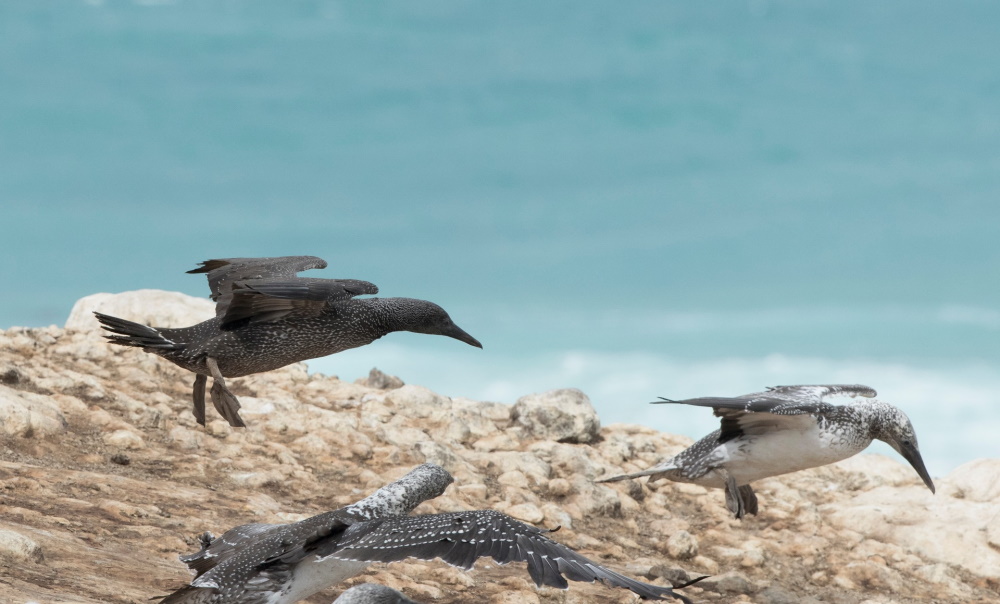
Karen Weil: I recall it was purebred Cape Gannet juvenile. There was no interbreeding occurring as the Capes were accepted but kept separate by the Australasian Gannets.
Karen Dick: For people that might want to see this bird, there are volunteers who take people inside the fenced area to see the gannets. Our Victorian members may be able to supply details.
Sonja Ross: I think you contact the Visitor Information Centre at Portland and they arrange with a volunteer to meet you in the car park there and take you in. Unfortunately the person I knew of being involved with this has gone. For more information on the Australasian Gannets at Point Danger, contact the Portland Visitor Information Centre. Ph. 1800 035 567 Email portlandvic@glenelg.vic.gov.au.
KJ Hocking I saw them in January. The guide took me in and I was the only person for a blissful 30 mins. I’ll dig up some photos.
 Women Birders Australia