P Plater ID CHALLENGE 16 July 2020 — by Pamela Keil
Every year at the Alice Springs Desert Park, the grevilleas bloom through September and into October. Different species bloom at different times, and the birds love it! And of course, so do the birders.
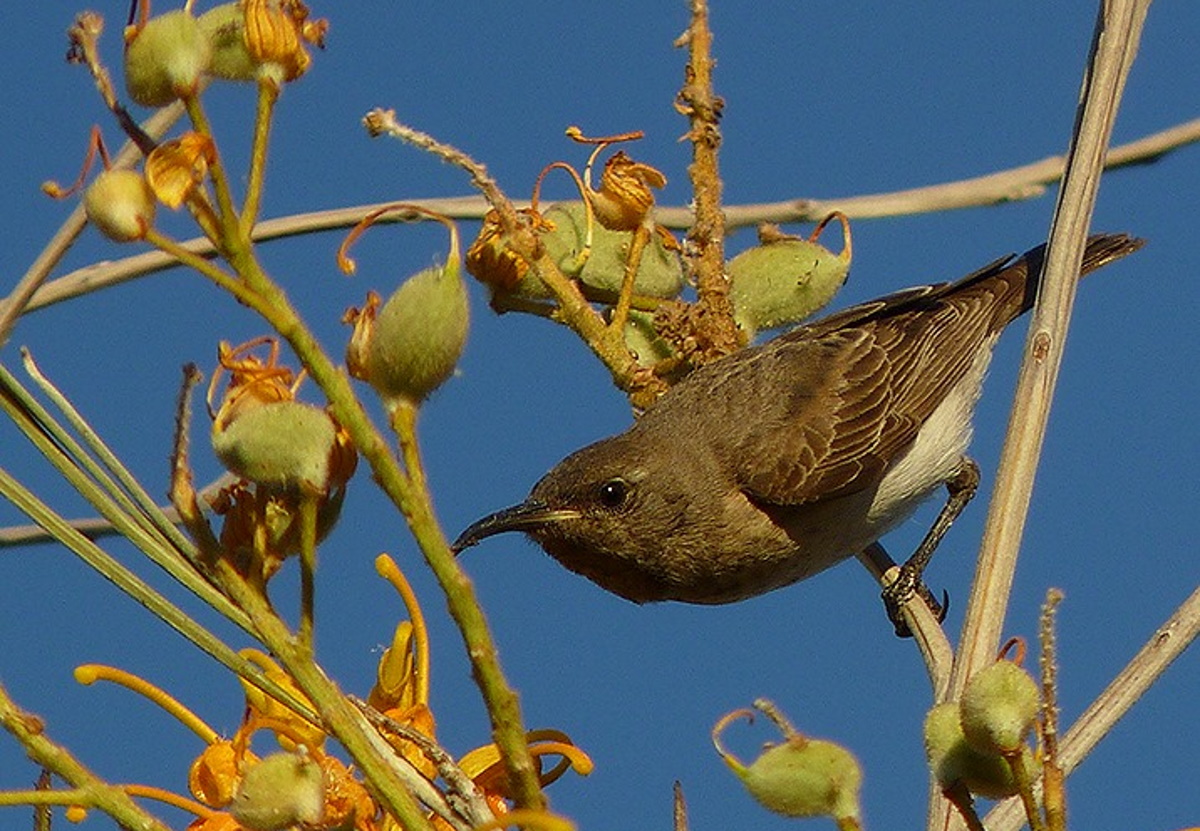
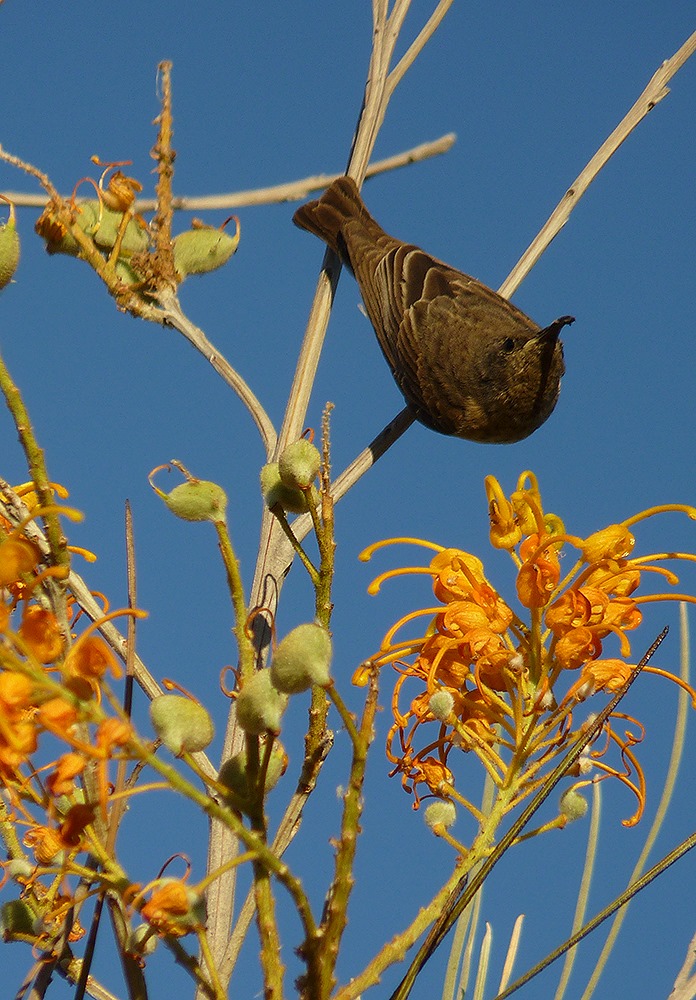
I photographed this bird feeding on the Honey Grevillea in October 2012.
L-Platers: See if you can narrow it down to a few species, then give your best guess for which one it is.
P-Platers: Try to ID the species, then tell me what you can about age and sex.
Note: In these challenges, we often post a single image to challenge you a little more, and to raise bird IDs to a harder level. And also because we know that often in the field, you only manage to get a fleeting view or a single shot before a bird flies away. However, when trying to ID a bird, it’s always great if you can see it from many different angles, and even poor photos can be helpful. In fact, when requesting ID, if you post a single image, people will often ask if you have any other photos so they can see all the ID features.
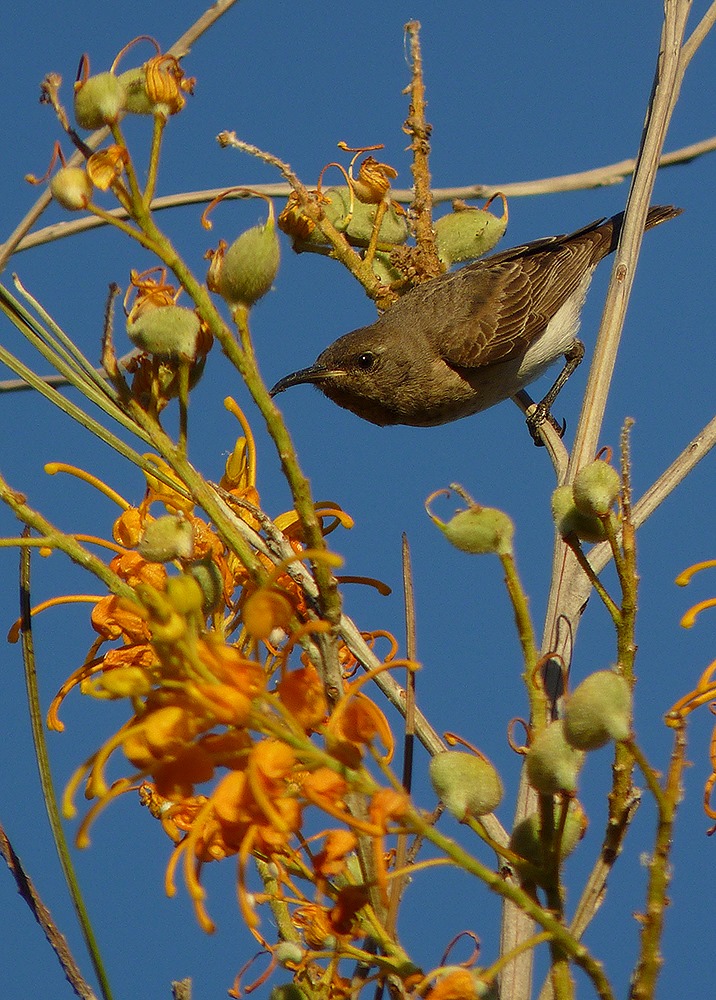
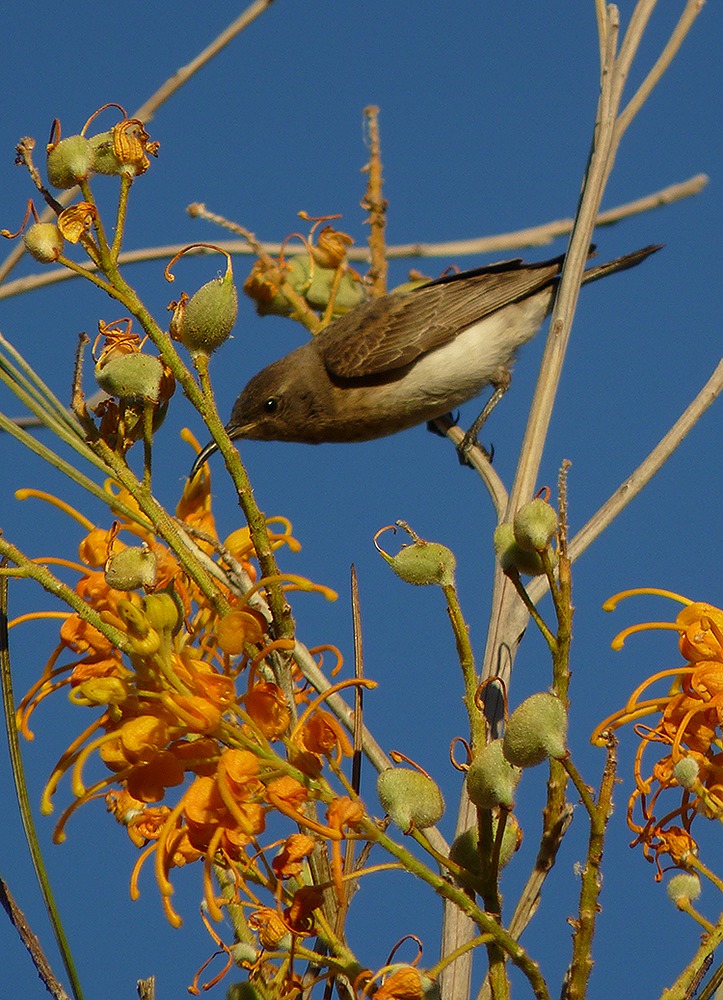
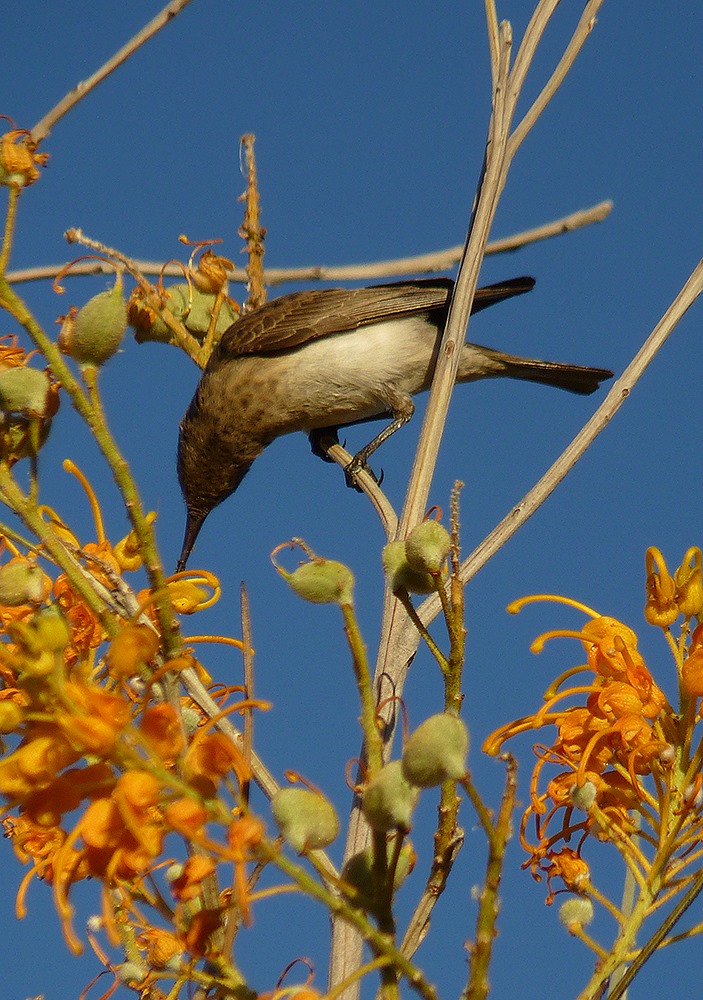
For this challenge, I’ve decided to treat it like a real ID request, and so I have provided you with photos showcasing all the angles of the bird so you can clearly see all the distinguishing features. To aid in your and other’s learning, please note which features helped you to reach your ID.
Solution:
This is indeed a Black Honeyeater Sugomel nigrum, and an adult female.
The long curved bill indicates that this is indeed a honeyeater. The length of the bill and overall brown colour pattern narrows it down to a few possibilities. Some species, such as the Dusky Honeyeater, can be ruled out by their range (though be careful as vagrants do occasionally happen). Dusky Honeyeaters are also darker all over, without the paler belly.
In Alice Springs, the most likely species that look similar are Brown Honeyeater, Black Honeyeater (juvenile or female), or Pied Honeyeater (juvenile or female). In the field, size can help you rule out Pied Honeyeater, which are noticeably larger. However, if you can’t judge size, then Pied is also ruled out by the lack of patterning on the wing and the black bill (Pied HE has a grey bill).
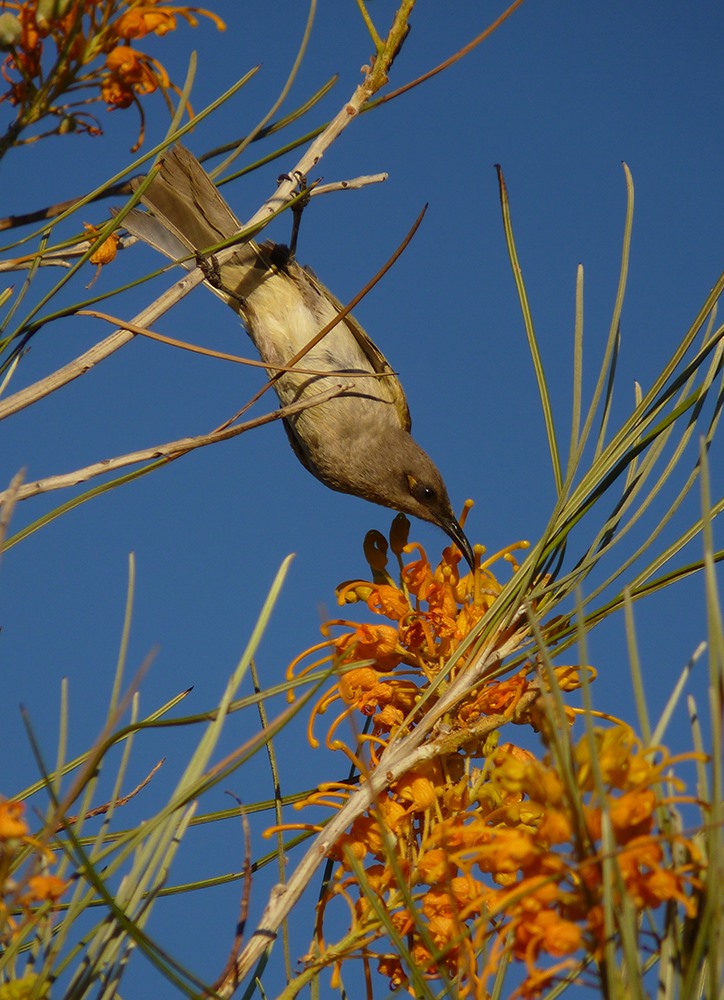
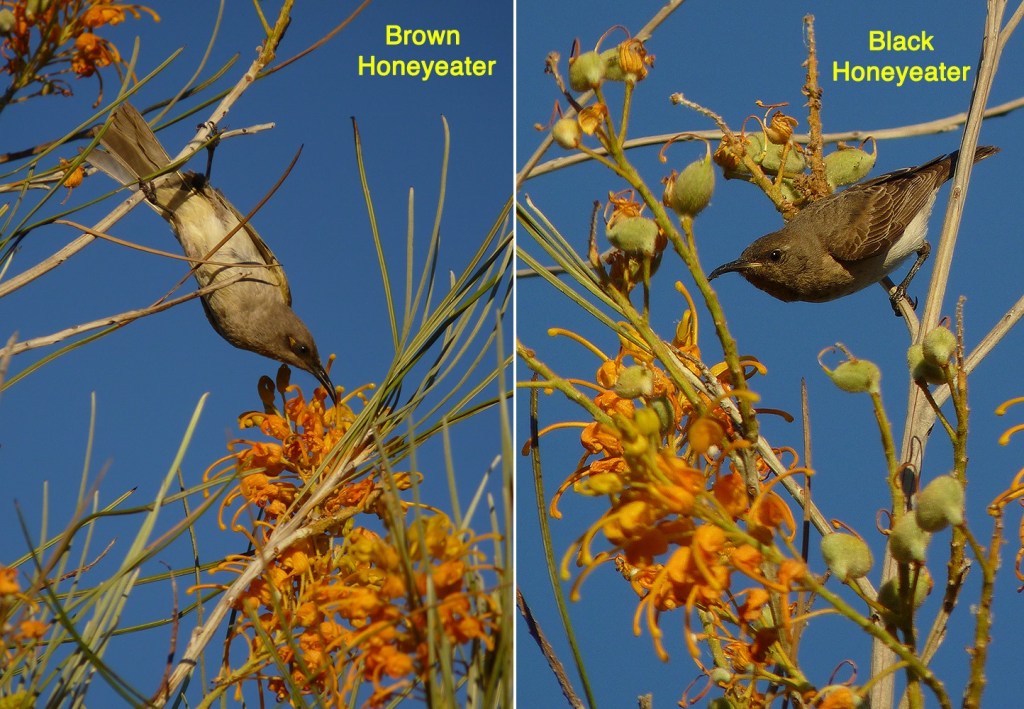
Brown Honeyeater and Black Honeyeater are much more difficult to tell apart in the field as they are similarly sized. In Alice Springs, Brown Honeyeater are present year round and are very common around town. Black Honeyeater are more nomadic and only pass through town occasionally when the hakea and grevillea are flowering. So, here, it is common to mistake a female or juvenile Black Honeyeater for another Brown Honeyeater if you’re not looking carefully. I’ve attached a photo of a Brown Honeyeater in the reply to this comment so you can see the similarities and differences.
Some differences to look for:
Brown Honeyeater have a slight yellow/green tinge to their outer wing feathers whereas Black Honeyeater are overall dull brown.
Brown Honeyeater have a bare patch of skin behind the eye which turns creamy yellow in adults but is often difficult to see in juveniles.
Black Honeyeater males are easy to tell apart, but the females and juveniles look very similar to a Brown Honeyeater, and are similar in size. Young birds of both species have a puffy creamy/yellow gape and some yellow on the bottom mandible. Females of both species and non-breeding male Brown Honeyeaters have a small yellow patch just at their gape, but it is not puffy or as extensive as in the juvenile birds.
In Black Honeyeater females and young, there is a pale eyebrow patch of light feathers above and behind the eye. This is different to the triangular patch of bare skin directly behind the eye in Brown Honeyeater. The mottled feathers on the breast are also more pronounced in Black Honeyeaters than in Brown. So, with the small pale yellow gape (not puffy), and the pale stripe behind the eye which can be seen clearly in the second photo , I ID’d this as an adult female Black Honeyeater.
For comparison, here is a photo of a Brown Honeyeater taken a few minutes earlier on the same bush.
Here’s a direct comparison of the two species. These are the most difficult to separate in the field. Note that the Brown Honeyeater is an adult male in breeding flush (no yellow on the bill) while the Black Honeyeater is a female.
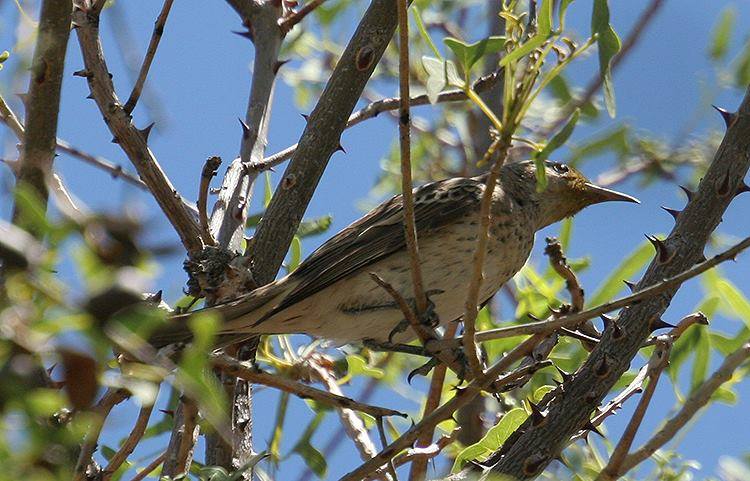
This is a juvenile female Pied Honeyeater for comparison. Also taken at Desert Park, but this bird was feeding on a flowering bean tree in January 2014. Note the different bill and build of the bird, as well as the pattern on the wing.
Comments:
Penny Gillespie: Pamela Keil why not a juvenile black?
Pamela Keil: They generally have yellow extending onto their lower mandible rather than just at the gape. And the gape is more “puffy”. This is probably a young female, as Janine suggested, but not quite fully juvenile plumage. If you look at the photos on ebird of female Black Honeyeaters, you can see the slight cream/yellow right at the gape.
https://ebird.org/species/blahon1
Pamela Keil: Penny Gillespie I found this image in the eBird photo library. You can see here what the brighter yellow gape, yellow onto the bill, and slight “puffiness” of the gape looks like in a young bird: https://macaulaylibrary.org/asset/189767961?fbclid=IwAR1wYr85N-yIVrtwo-iyWMtHK6cmCfwzcThgmYeLcpymnPs_Om6BZC5c92I#_ga=2.252350350.600516209.1595032057-1939538376.1595032057
 Women Birders Australia