Kindy ID CHALLENGE 11 June 2020 by Janine Duffy & Lynette English
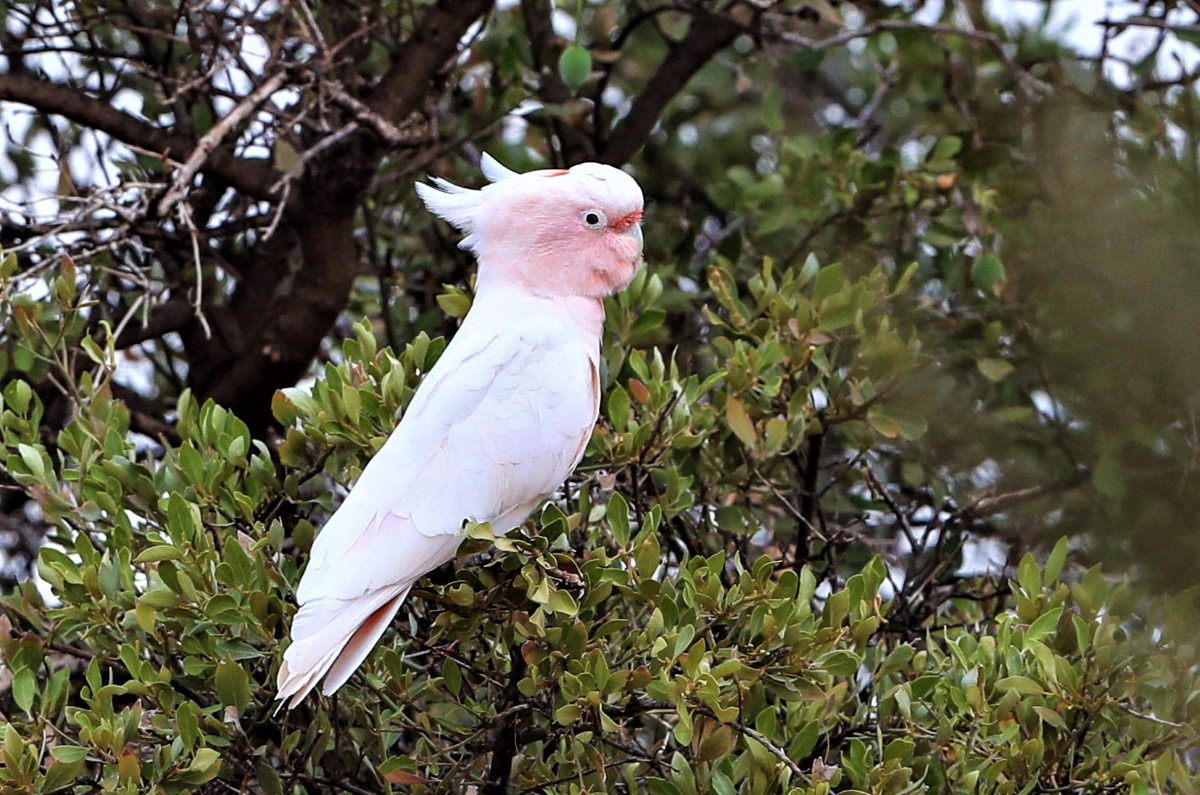
Who is this stunner? Seen and photographed by Lynette English at Kunoth Bore, near Alice Springs in January.
Size: big Behaviour: feeding fairly quietly, in small groups or pairs, in trees. Occasionally on the ground.
BTW they have two widely-accepted common names – either is fine.
Solution:
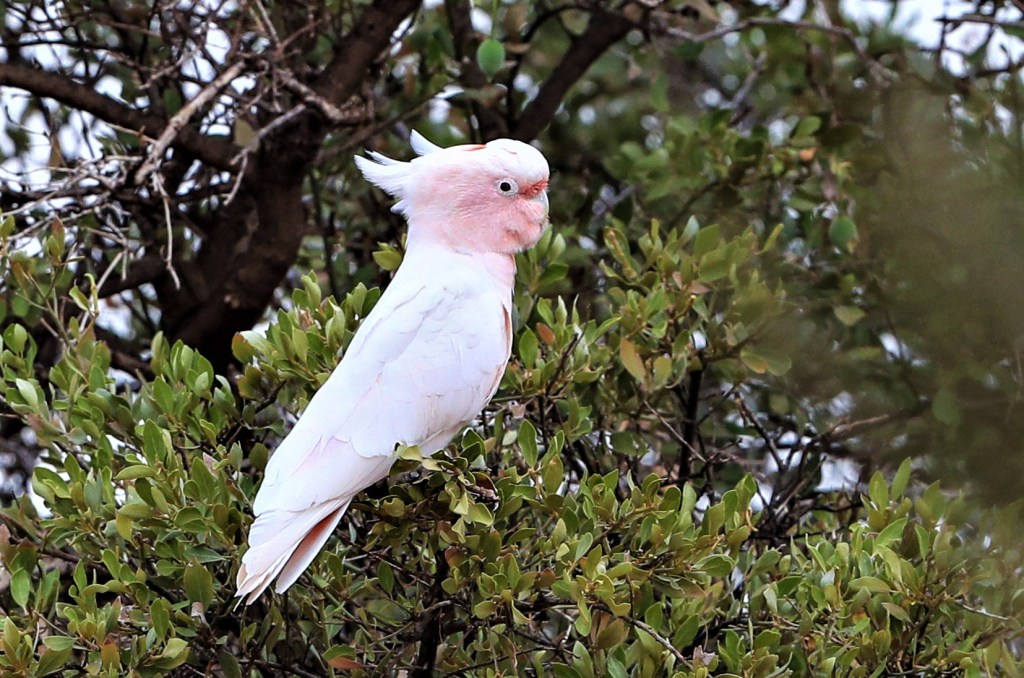
Pink Cockatoo (Major Mitchell’s Cockatoo) Lophochroa leadbeateri
They are pretty distinctive, the only cockatoo in Australia with a pink head, white wings and large white, red and sometimes yellow crest. They could only be mixed up with a Galah, which has grey wings and a short pinkish crest. The Galah’s crest only lifts up, whereas the Pink’s crest lifts up and forwards, making a broad fan.
Female and male Pinks are pretty similar, with just a difference in iris colour: female reddish brown, male black. I have noticed that juveniles are paler, more washed out. ABG says they have a pale brown iris.
There are two subspecies: leadbeateri in western NSW, sw QLD, northern Vic and SA; mollis in WA, NT and SA. This one would be mollis, so if she/he raised her crest you would see she has no yellow band across the red.
Check out the crest colour on all these Northern Territory birds, ssp mollis here: https://ebird.org/media/catalog?taxonCode=pincoc1®ion=Northern%20Territory,%20Australia%20(AU)®ionCode=AU-NT&q=Major%20Mitchell%27s%20Cockatoo%20-%20Lophochroa%20leadbeateri
and compare to the New South Wales birds, ssp leadbeateri here: https://ebird.org/media/catalog?taxonCode=pincoc1®ion=New%20South%20Wales,%20Australia%20(AU)®ionCode=AU-NSW&q=Major%20Mitchell%27s%20Cockatoo%20-%20Lophochroa%20leadbeateri
This is one of the more threatened cockatoos in Australia – they used to be plentiful in Victoria’s deserts, but with the loss of old growth Callitris trees for nesting, these gentle birds lose out to bossier birds.
I have enjoyed seeing large flocks of Pinks at Mungo National Park, southwestern NSW, especially in autumn (April) when there’s lots of juveniles and they all seem to flock together. Have seen flocks of 40+ there. Sensational, against the red sand.
You might notice I’m calling it a Pink rather than a Major Mitchell – I heard a bit about Major Mitchell and have since stopped using his name in conjunction with this gentle, elegant bird.
 Women Birders Australia