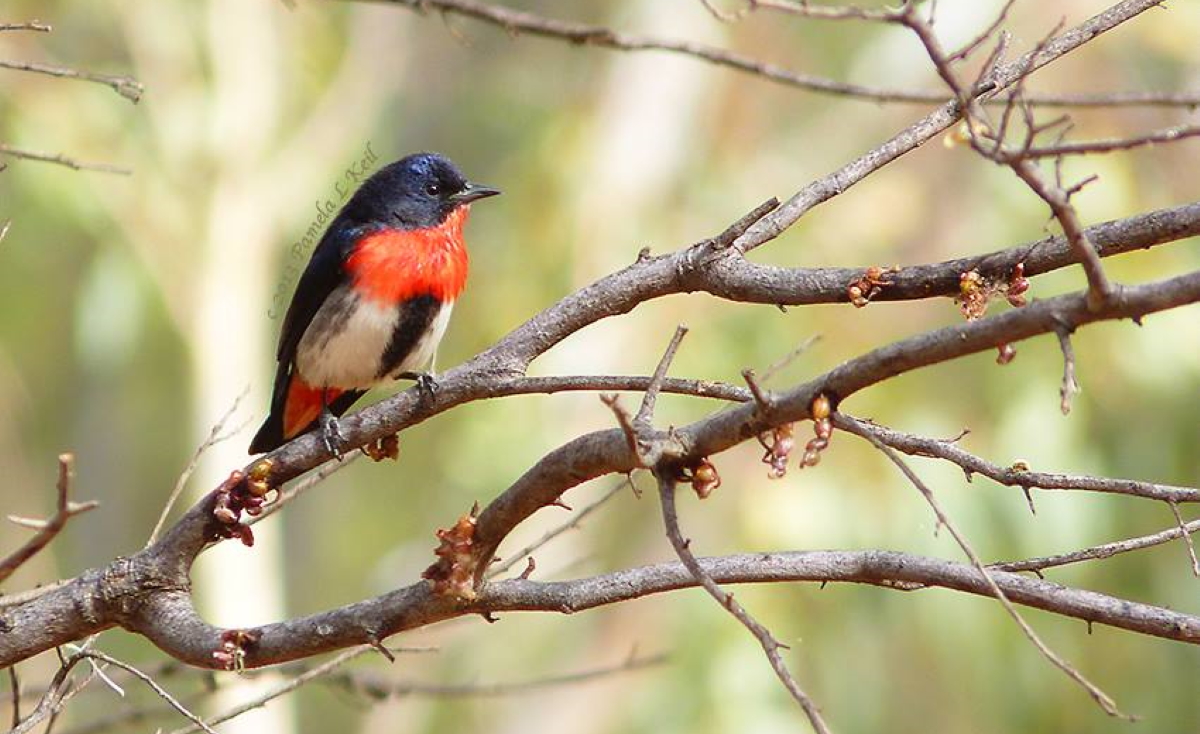
ID CHALLENGE – 6 July 2020 – L-Plate by Pamela Keil
This little bird was seen living wild in the gardens of the Alice Springs Desert Park in November 2013, but they’re a year round resident here. They like to hide in dense foliage, but will also pose in the sun every once in a while. Active at defending their territory and food plants. I’ll leave the rest of the behaviour description to after the challenge. Try and pick the sex as well.
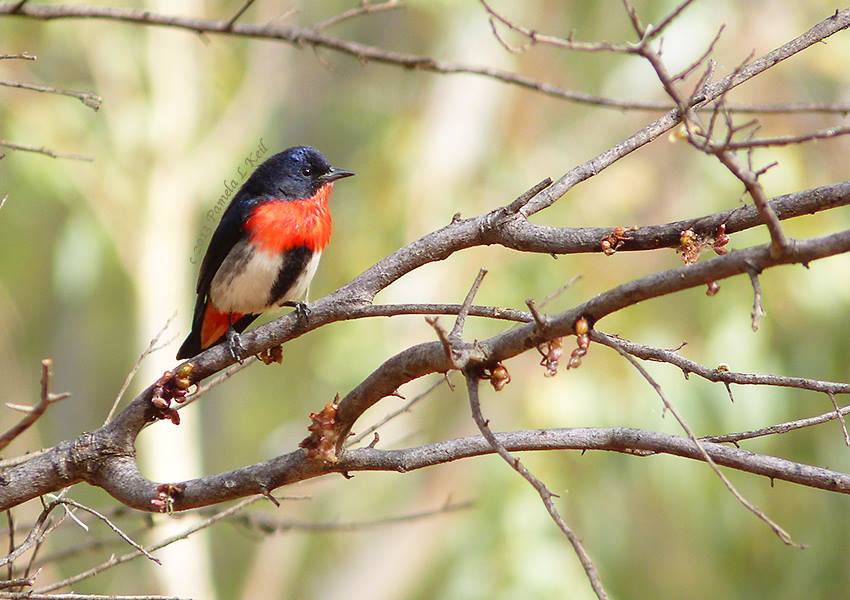
P-plate extension — Can you pick out the important clue in the photo that has been left behind by the bird, and describe the ecological role these little guys play?
..
Solution:
This is one of those birds that are found right across mainland Australia (apologies to Tasmania for missing out), but you might not notice for years. Once you notice them once, though, you’ll smile every time you hear their beautiful whistle or see their bright red flash. The colour of the males is very distinctive, and once learned, is one of the birds you’ll never forget.
..
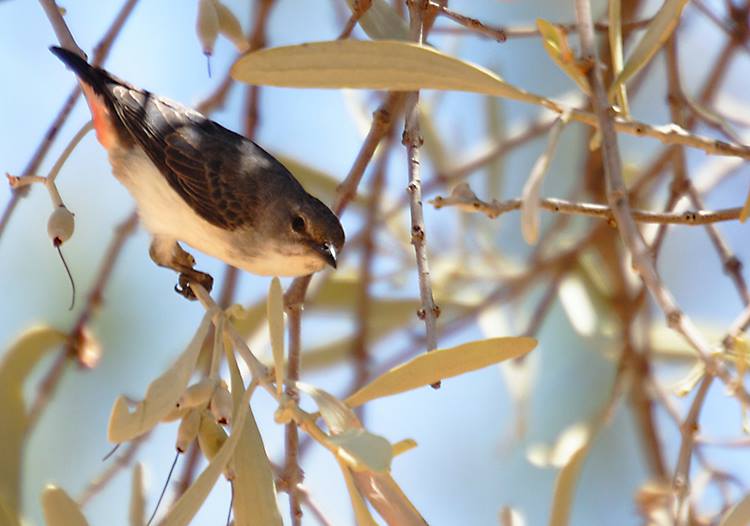
This bird is the tiny but beautiful Mistletoebird. The original image was of the male, and I’ve added a photo of the female for comparison. The male is stunning in his black tuxedo with his black tie, and beautiful red cummerbund and red bow tie. The black on the back shimmers a brilliant blue/purple in the sun. The female and juvenile birds are much less showy, with just a hint of pink under their tail in the “vent” area. This pink on the vent is not seen in any other species, and along with the stubby tail and pointed bill allows you to ID a Mistletoebird with confidence once you know them.
Be prepared to battle with your spell-checker and autocorrect if you write about them, as Mistletoebird really is all one word – and the word describes the animal perfectly. It’s a bird that lives in and on mistletoe – often nesting in the dense foliage of the mistletoe clumps. It feeds mainly on mistletoe berries, but will also drink the nectar from the flowers.
Mistletoebirds are one of the smallest birds in Australia, with only Weebills truly smaller by length. Partly this is because of the very short tail that barely extends beyond the birds rump. They’re the only Australian species in the flowerpecker family, which is found throughout Asia.
Like the other flowerpeckers, they still have a brushy end to their tongue, which allows them to sip nectar. But being so small, they are generally driven off any flowering plants by the much more aggressive honeyeaters. This has led them to finding their own niche here in Australia, and they’ve chosen mistletoe. It’s an interesting ecological story, with mistletoes in Australia now being largely reliant on the tiny Mistletoebird to spread their seed. Mistletoe seeds often won’t sprout if they haven’t passed through the gut of a bird. And the bird is the perfect little host.
It eats so much mistletoe, it gets the runs (many mistletoes are quite edible to people too, but we also shouldn’t eat too much). And so it poops very quickly after eating – before the seed is digested fully, but the protective coating is dissolved, and triggers it to sprout. Now a mistletoe sprouting on the ground wouldn’t do much good, so it needs to be up in a tree. The seeds are sticky, very sticky (and often called “snotty gobbles” because of their sticky slime). Even after passing through a Mistletoebird gut, the seeds are still sticky and stick to his bum. To get them off, the bird does a fancy little wiggle dance, and wipes its bum on a branch. Thus planting the next generation of mistletoe.
Mistletoe is usually maligned, but mistletoe actually plays a really important ecological role. You can read more in this article:
https://theconversation.com/mistletoe-the-kiss-of-life-for-healthy-forests-52137?fbclid=IwAR3vw_DWrd61SD6g1mg9zusLwYsBKUyrGbuIR1PEo6-mq3O8wYF1E6E-4b8
 Women Birders Australia