Wader Wednesday ID CHALLENGE 1 July 2020 – L Plate by Karen Dick
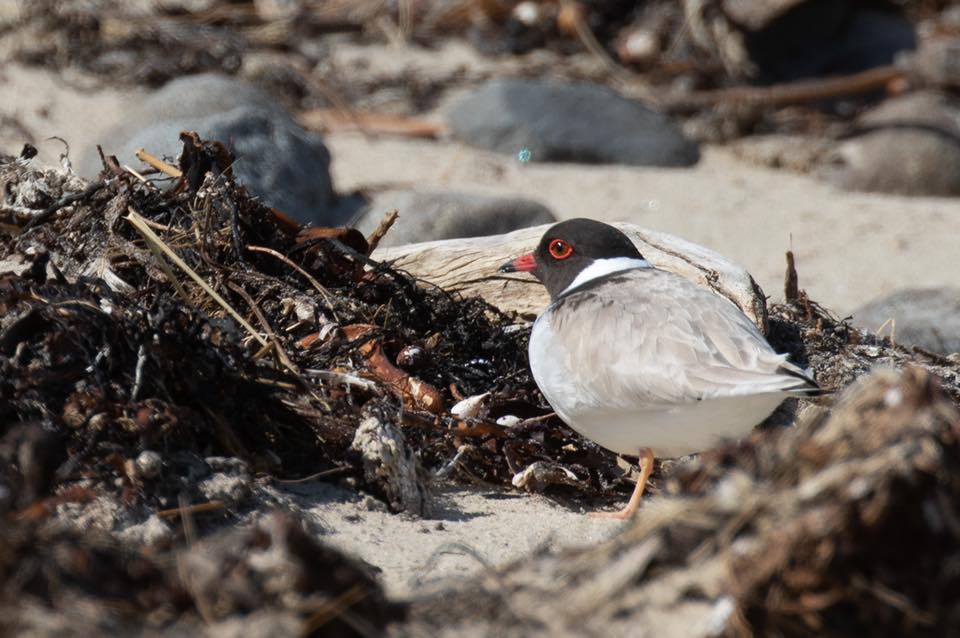
This beautiful little resident wader is one of my favourite birds. Mainly seen on beaches, usually in pairs or in family groups. It’s behaviour is very busy as it scuttles along the waterline during feeding forays.
Solution:
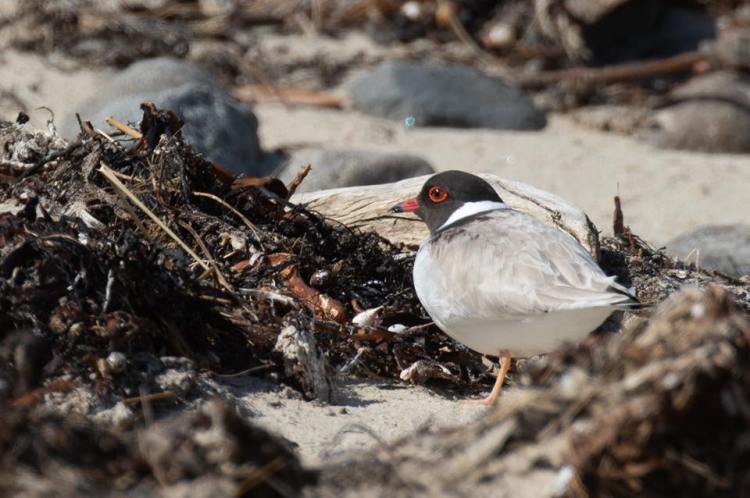
Depending on which nomenclature you follow, this gorgeous bird is indeed an adult Hooded Plover (Birdlife Australia) or Hooded Dotterel (eBird and IOC). Either way it is Thinornis cucullatus. This particular bird is subspecies cucullatus, which is the subspecies from eastern Australia. In WA, subspecies tregallasi has more black over the mantle. The species has greyish upper parts and very clean white underside with a black hood, clear white collar and red eye-ring. The short bill is red with a black tip. Juveniles have a greyish, mottled crown and face.
This stocky, diminutive shorebird is a resident of southern Australia, often on ocean beaches in Eastern Australia and more often on inland salt lakes in Western Australia. Not strictly a wader, they feed on small items of food that are washed up on the fringes of the water. Despite the striking colours, they can be surprisingly difficult to see, as they tend to blend in with the colours of sand, seaweed and debris that they often use as cover. They lay their eggs directly in the sand and are very vulnerable to impacts from human recreation, including 4WDs, dogs and horses.
Comments:
Sonia Sánchez: And now we know that western and eastern subspecies are genetically quite different, plus the eastern subspecies has a high genetic variation across its range (i.e. SA birds are genetically different to VIC birds and VIC birds are genetically diverse)! Hot off the press – https://link.springer.com/article/10.1007/s10592-020-01286-2
Sonja Ross: How are they going in Tasmania, Karen? I remember seeing them in a couple of spots when visiting.
Karen Dick: they are vulnerable here. I see them regularly in different spots, but disturbance and impacts from recreation are a significant issue here.
Sonja Ross: It’s still probably better than here in Vic. unfortunately.
Janine Duffy: I understand that the populations here that are most monitored are the most successful breeders. https://www.swifft.net.au/cb_pages/sp_hooded_plover.php#2018%20summary
Sonja Ross: Yes, some communities really look after their birds. BirdLife’s Beach-nesting Birds program has really helped, but at the same time I’ve seen people ignore signs and just walk through nesting areas, so education needs to continue.
Barbara May Taylor: I have seen one at Victor Harbor ( S.A.) volunteers work hard to protect those that nest on the beach each year
…
How can you help? Support BirdLife Australia’s Beach-nesting Birds Program either with a donation, or by volunteering to help monitor nests.
 Women Birders Australia