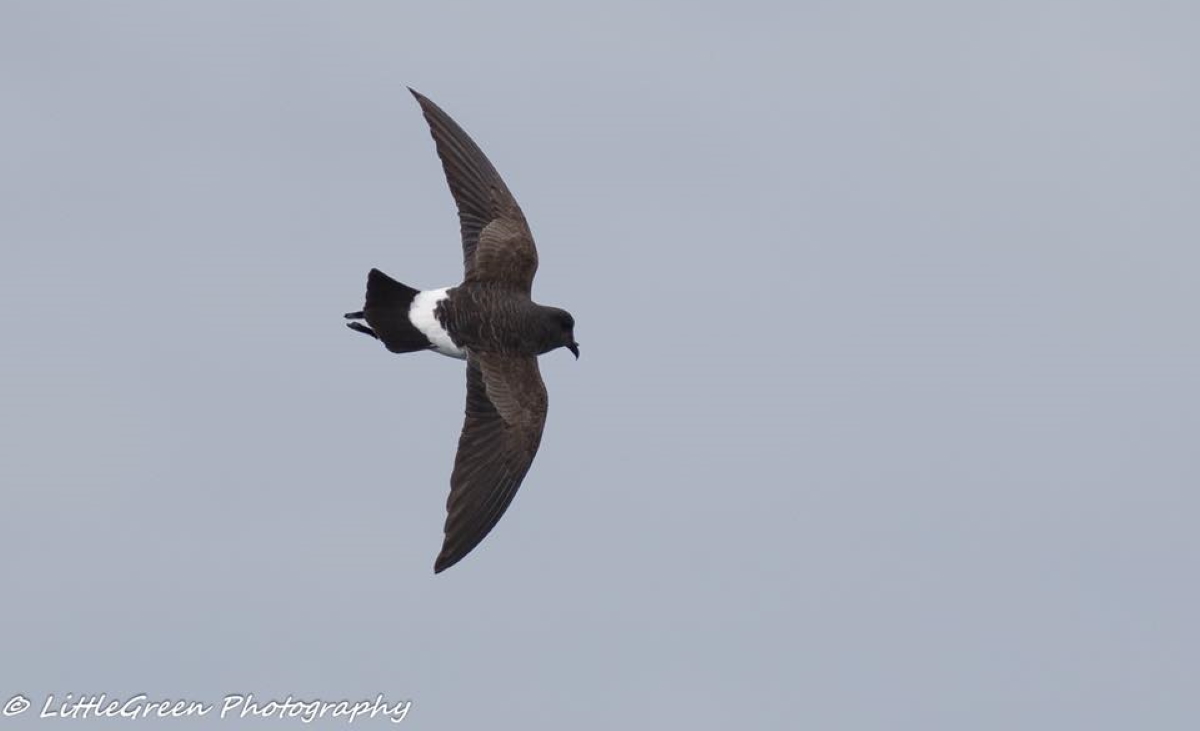
Seabird Sunday Advanced ID CHALLENGE 5 July 2020 – by Karen Dick
This bird was seen offshore from an Eaglehawk pelagic in Tasmania in January. Medium-sized within its family, It feeds by picking tiny morsels of food off the sea surface and flies erratically, while bouncing off the surface.
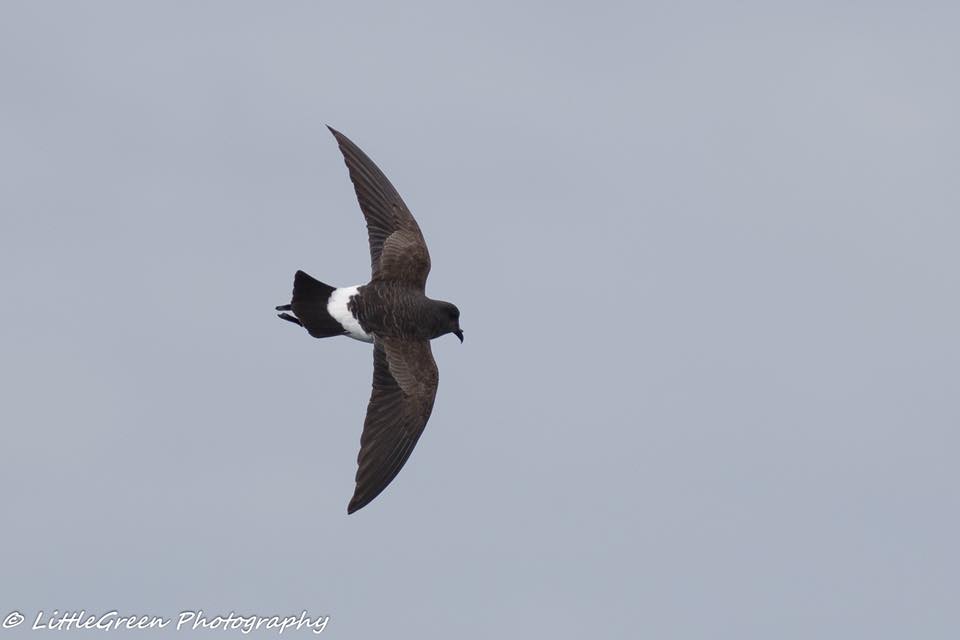
Solution:
Well done to everyone that had a go at this bird. I acknowledge that it was made very tricky by only having a single dorsal view, so am impressed by the workings that you went through.
This bird with the tiny bill and skinny legs trailing behind the tail has the features of the diminutive storm-petrels, so this where we start. As Sonja highlighted, it has an all dark upper side, with paler grey secondary coverts and a white rump. This leads us to White-bellied, Black-bellied and Wilson’s. As several people pointed out, the extension of the legs rules out White-bellied, although if the legs could not be seen, that wouldn’t rule out the others as birds can tuck their legs up into the belly so they don’t show!
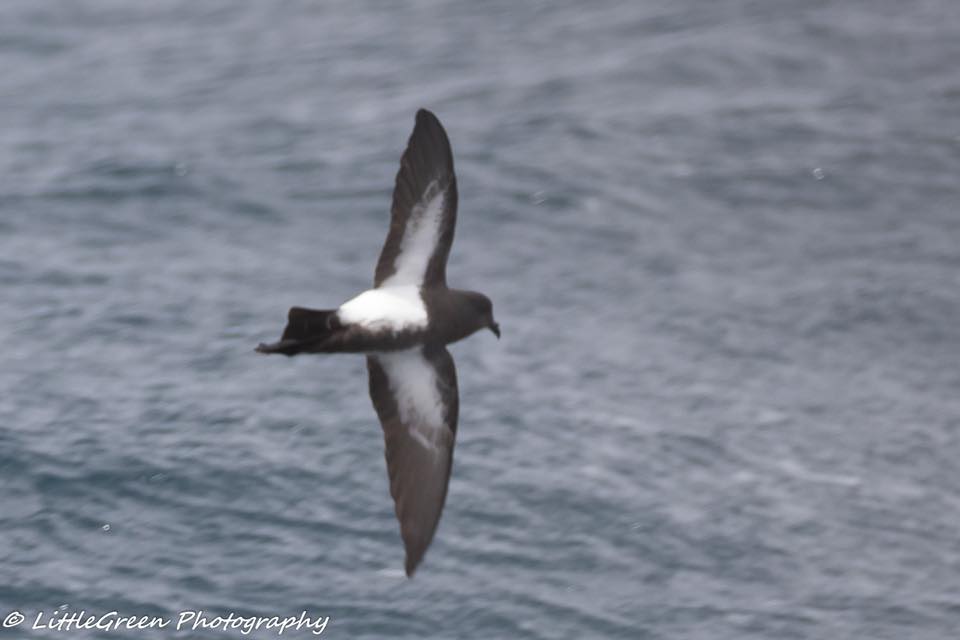
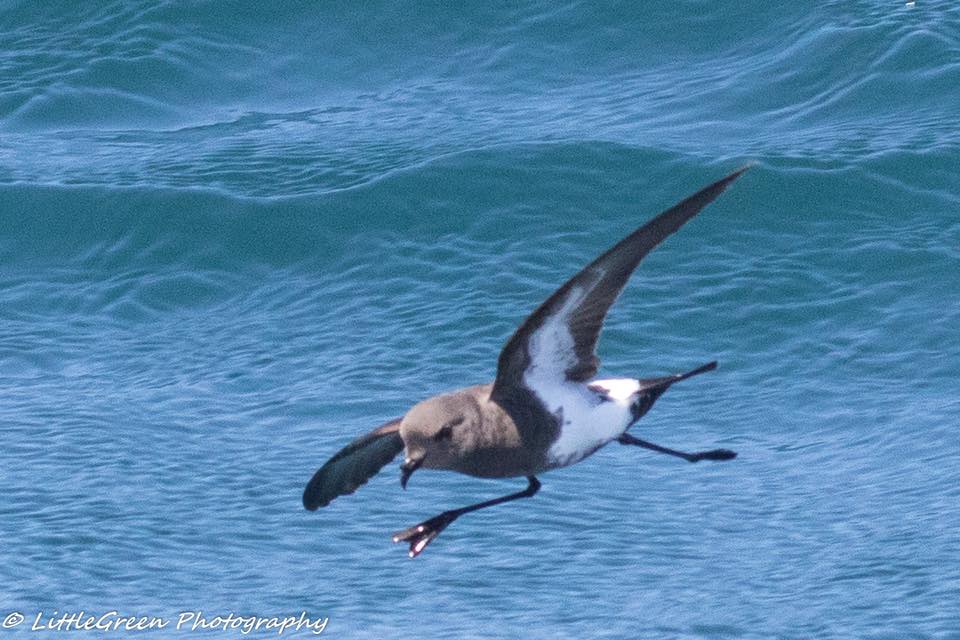
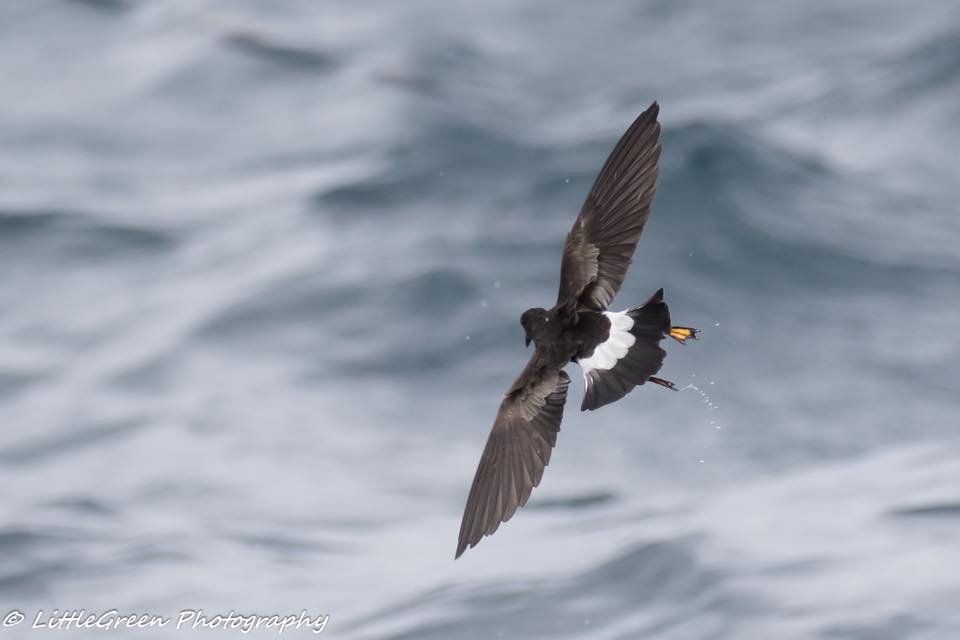
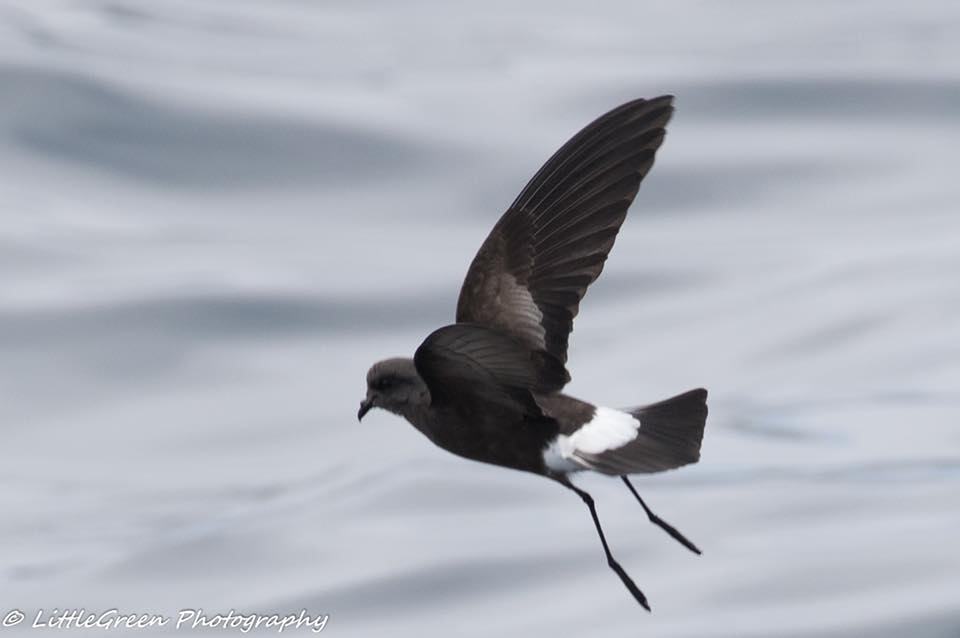
So we are down to a choice between Wilson’s and Black-bellied Storm Petrel. There are a couple of features that do help us. Note the pointed wingtips and scythe-like shape to the wings, the secondary coverts that are just paler than the remaining feathers and the hint that the white on the flanks extends up under the wings. These features are all consistent with Black-bellied Storm Petrel, as shown in photos above. Photos below show a Wilson’s Storm Petrel for comparison. Wilson’s Storm-Petrel have blunter wings, which does stand out in the field, and the paler coverts tend to be more silvery. In the field, Black-bellied Storm-Petrel are noticeably larger than Wilson’s.
I never rely on the yellow webbing in the feet of Wilson’s, because it’s seldom easily visible to the naked eye.
Comments:
Sonja Ross: The size and shape indicate Storm-Petrel. The white rump limits it to 3 of that family that are regularly seen in southern Australian waters: Wilson’s, White-bellied and Black-bellied. The feet are trailing which cuts out White-bellied, using ABG. Based on this image alone I wouldn’t be able to decide between the two that are left. The clues in the description, medium-sized and flies erratically mean I think it is a Black-bellied Storm-Petrel.
Betty Nottle: Black Bellied Storm-Petrel. It’s actions match the description in my book, also Wilsons have yellow feet which appear to project a lot further behind the tail.
Shirley Tongue: At first glance, I thought it was a Wilson’s Storm-Petrel, but the “medium-sized within its family” ruled that out, as Wilson’s are titchy (note the empirical scientific terminology there 😉). That sent me to ABG to remind myself which other Storm-Petrels are dark with white rumps. Assuming that it isn’t a rare vagrant or a White-bellied SP seriously outside its range, that narrows the field to Black-bellied Storm-Petrel. It’s certainly easier in the field, when you can usually get at least a glimpse of the underwing and belly. Watching Storm-Petrels bounce off the water is a delight – and it always amazes me that such tiny birds can survive out at sea.
Julie McLennan: I thought the Wilson’s Storm-Petrel looked most like this bird, but that would be in small size, not medium. So Black-bellied as matches picture and behaviour description and size
Catarina Gregson: Totally out of my territory so going with the ABG and it lead me to Storm Petrel and I think it looks like Black-bellied Storm-Petrel with the toes projecting out, the white rump and the bill looking right. The outline of the wings is sharp and looks like the Black-bellied in the book. I am amazed when I read the size of this bird!
Janine Duffy: Ooh this is hard. But I think it’s a Black-bellied Storm-Petrel rather than a Wilson’s. Why? That sticky-out tube nose thing – how weird and cute is that? Poor wee fella looks like he has a big pimple on his nose!!! I never remember seeing that so pronounced on a Wilson’s. Then when I look at ABG the Wilson’s have white quill bases on their outer tail feathers (though this does not show on many pics). Plus coverts are dark grey, only a few shades lighter than the wings & back – Wilson’s should be light grey and contrast more strongly. But maybe I’m talking myself into the rarer sighting (and the one I haven’t seen yet!!!)
 Women Birders Australia