L, P, and Advanced Super Saturday – ID CHALLENGE – 4 July 2020 – by Pamela Keil
This is a Super Challenge as it has more than one bird for you to ID, with a theme based around birds of prey in varying shades of brown. All the shots show the underwing and tail in flight, and most show the head profile. They all show the key features you need for an ID.
There should be something in this challenge for everyone! L-platers there are a few species you should recognize, and go ahead and give the others a try! P-platers should be able to narrow them all down to one or two possibles… And Advanced – please give us the reasons for your IDs.
Also a story — in 2008, my husband and I took a meandering road trip that wound through the Northern Territory, from Alice Springs to Nhulunbuy. The trip was even more meandering as we made a detour to Lajamanu to pick up a friend along the way. Along the whole trip, we had one rule — stop and photograph any raptors we saw! (Also other cool birds, but we stopped for raptors in particular.)
These shots are (mostly) from that trip. They’re all of birds we saw and photographed along the way (though #5 and #9 were taken at other times as my images of those birds from the 2008 trip were not suitable for this challenge). I’ve put numbers on the photos… Some additional location information for each one:
1 – Taken along the Buchanan Highway (there were also heaps of Bustards around!)
2 – Taken near Lajamanu on the Lajamanu Road
3 – Taken on the Central Arnhem Hwy, by a roadside stop with a great overlook, near the Stuart Hwy crossing; this bird was soaring below us for the most part, but I did get one shot of it’s underside before it disappeared. Not the best shot, mind you… but a shot.
4 – Taken along the Buchanan Hwy. This bird was really showing off for us, it did several passes, flying low above the vegetation.
5 – Taken along the Tanami Track, but in 2017 not 2008. However we did see one on this same stretch of hwy during the trip, so I’m including it.
6 – Taken along the Buchanan Hwy
7 – Taken on the Lajamanu Road, near the Tanami Track
8 – Taken along the Tanami Track, near Alice Springs
9 – Taken in South Australia, in the Adelaide Hills, in January 2007, but we saw the same species on the trip through the NT, just didn’t get an underwing shot of it!
10 – Taken near Nhulunbuy, NT.
Hope you enjoy the challenge!
Solution:
First I’ve given some general tips for raptor ID. Read on for specific reasons for the ID for each of the birds.
Raptor ID
The thing that scares us all. Hopefully this guide will help people feel a bit more comfortable when it comes to these awesome birds. And remember, we all still get that one that stumps us.
The first rule of raptor ID, especially the all brown ones, is ignore the colour to start. Unless it’s a unique colour pattern, the best thing is to look at shape first, then start looking at colour patterns. Wing & tail shape can help you ID quite a few of them. How long is the tail relative to the body? Does it end in a blunt/square end or is it rounded/pointed/forked? How wide/long are the wings? Do the wings come to a point or end in a series of “fingers”?
Of particular importance in IDing raptors is something called “gizz” here, or “gestalt” in the US. This is the overall feeling of the bird, the first & dominant impression. When you take a look at a bird in the field, you’ll see how it’s flying, it’s general shape, the habitat, and a quick look at the colour pattern. This overall sense is the gizz. I’ll try to narrow down the key features of gizz for each of these birds, but it’s something that you’ll really develop with practice over time.
After taking into account shape and gizz — then you can look at the colour patterns. Generally the important areas to look at are the underwing colour pattern, the colour of the bill and cere (area just above the end of the bill), and any facial patterns.
On a final note, just remember that birds of prey moult sequentially (one primary feather at a time, symmetrically on each wing and in their tails). This can sometimes affect the shape of their tail and wing tips. Also, when they’re manouvering in flight or diving, their wings can go from distinct fingers to something that looks like a point and their tail can spread, hiding the shape. So… it’s a good idea to take into account all of the ID features, not just relying on one or two.
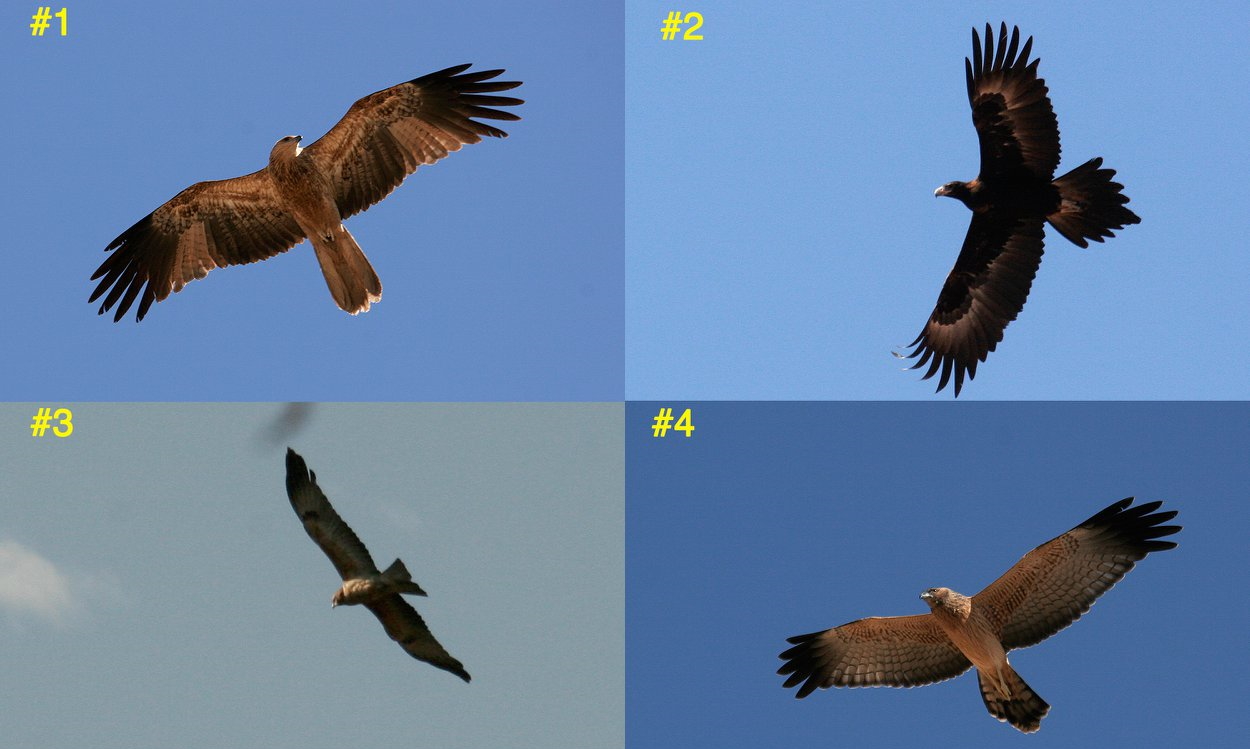
Bird of Prey #1
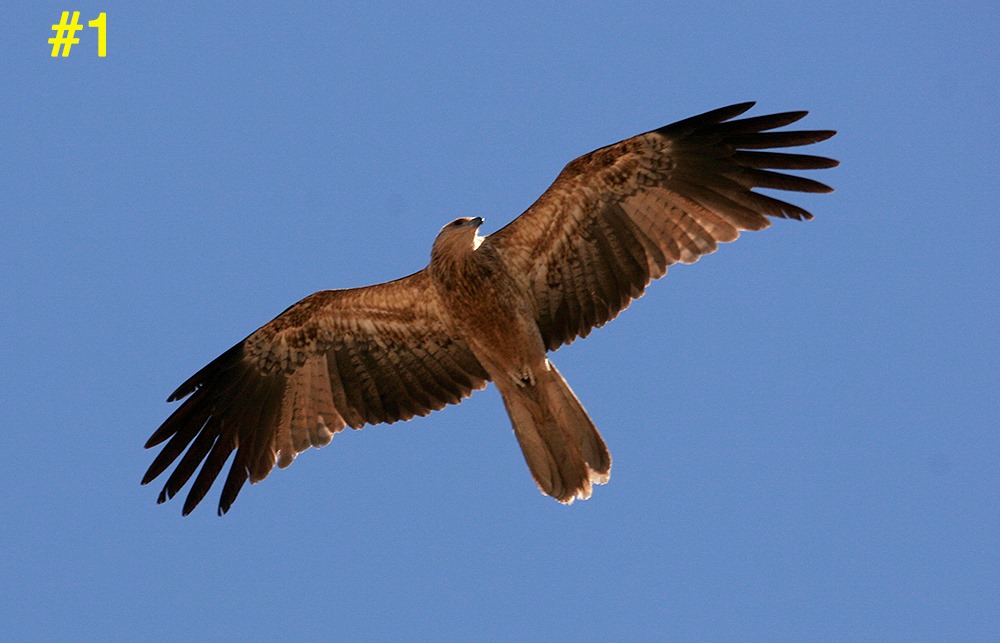
Many of you were able to pick this common bird of prey. This is a Whistling Kite.
Gizz — this bird is often seen soaring high up on a thermal around fires and over riverways and waterholes. They’ll also patrol along the roads, soaring much closer to the ground, looking for roadkill. They are an excellent fishing bird, and inland Australia’s only fishing raptor. They can be seen hanging out with large flocks of Black Kites, but tend to be found in pairs or small family groups themselves.
Shape — broad soaring wings that end in a series of six fingers, long (as long as the body or slightly longer) paddle-shaped (slightly rounded end) tail. This tail is used like a rudder when the bird is fishing, and it can turn on a dime. Grabbing a fish off the water, or a lizard off a rock. The bill/head ratio is relatively small compared to some of the other raptors.
Underwing Pattern — Just inside the fingers, which are dark, is a pale patch in the primaries. This along with a slightly paler shoulder area gives them a slight M-pattern.
Possible mix-up if you just look at the underwing pattern is with a light morph Little Eagle. Compare this to the true M in bird #5 — and also compare the shape of the bird’s wings and tail.
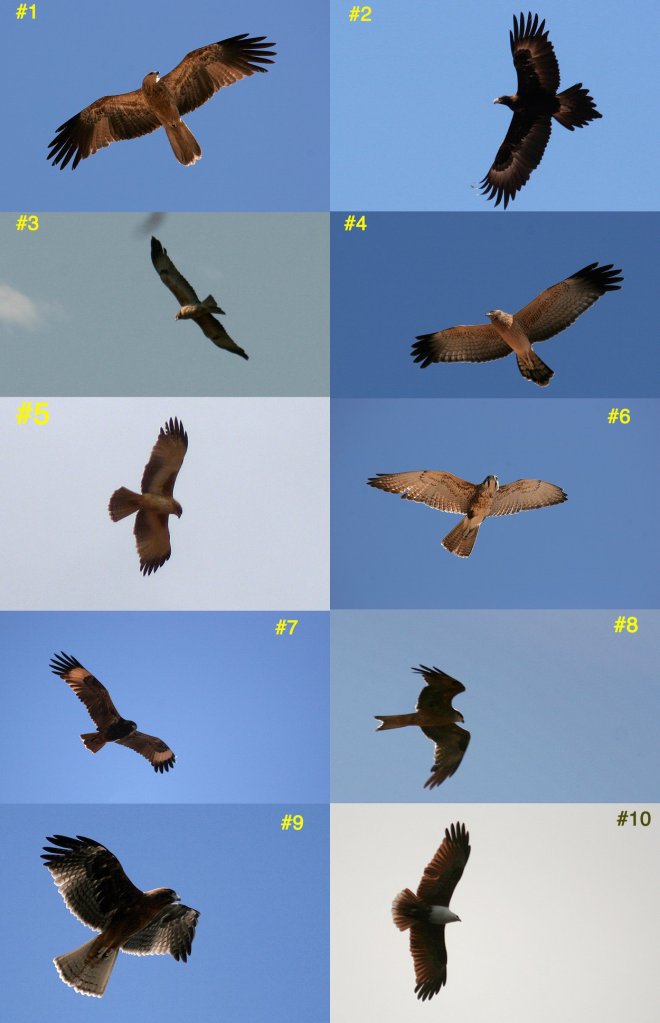
Bird of Prey #2
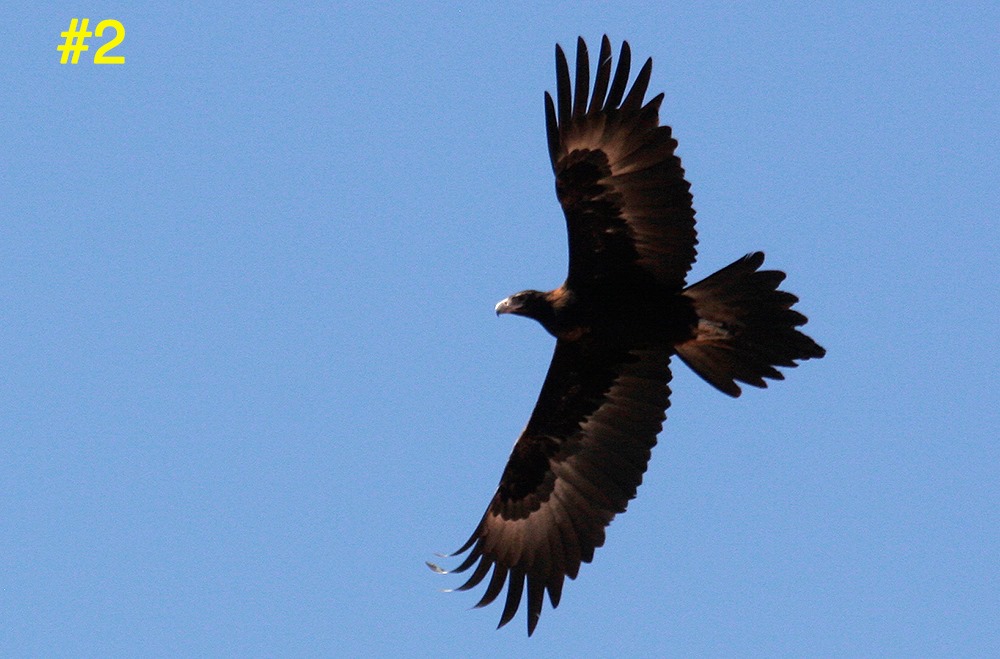
I think most of you got this one… This is a Wedge-tailed Eagle.
Gizz — this bird is often seen riding the thermals to get to a high vantage point, or soaring high overhead. When they soar, their wings are tipped up slightly. This gives them great stability in the air — if one wing starts to dip lower, the lift on that wing is automatically increased (lift is greatest when perfectly horizontal), which lifts the wing back up as the other tips down. This allows them to soar without any effort to remain level. The huge size is another good indicator. These birds are also often standing by roadkill or found along the roads.
Shape — the shape of this bird is distinctive. Huge soaring wings with 6 fingers and a giant wedge-shaped tail like a kite (a toy flying kite, not the bird, though they are related). If you see that tail, you’re golden. A giant beak compared to the head also helps you confirm that this is an eagle. When standing, you’ll also see that the feathers go all the way down to the bird’s feet.
Colour — in this case colour helps you to ID the bird’s age. The paler/more golden the bird, the younger. A really dark bird like the one seen here is probably over 10 years old. You can still see a bit of pale in the underwing, just where the primaries meet the coverts.
In the air, if you see that diamond shaped tail — there’s not really much else that you can mix this bird up with. But be careful with birds in moult, and possible confusion with immature White-breasted Sea-eagles. On the ground, I’ve occasionally seen people confuse Black-breasted Buzzard with the Wedge-tailed Eagle, but look out for the long tail, big bill, and feathered legs.
Bird of Prey #3
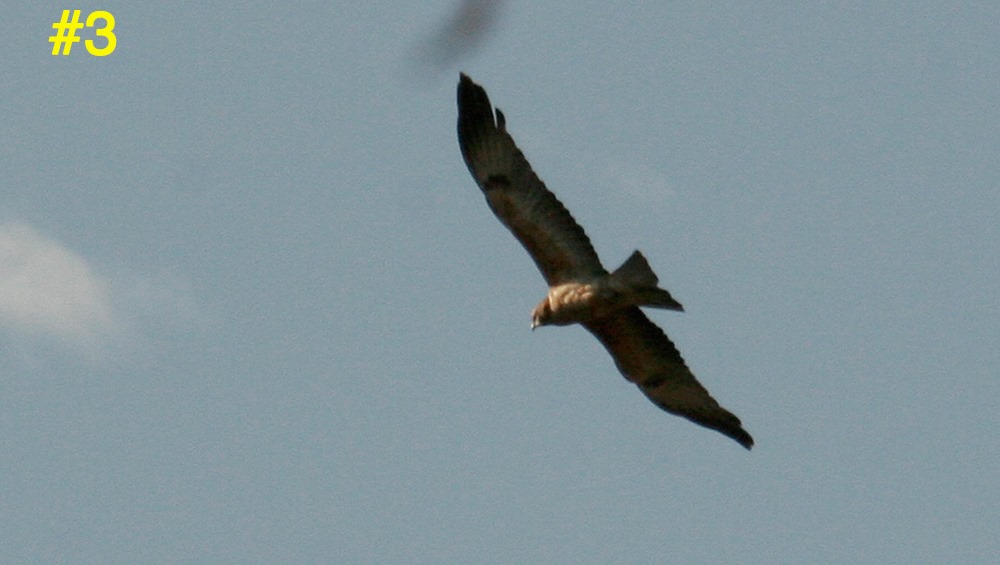
This one is a tough one — and a tough shot to tell it from, but a couple people did get it. This is a Square-tailed Kite.
Gizz — unlike the Black and Whistling Kites, this bird tends to be found alone. It hunts above the tree tops, and likes to grab birds and nestlings from the tree tops. They soar and use their tail as a rudder to keep them up in the air. Its wings tend to be held upswept and very far forward.
Shape — This bird has very long soaring wings with six fingers at the end (though the fingers are pulled together in this shot as the bird dives slightly). The tail is squared off at the end, with the inner tail feathers just slightly shorter than the outer so that it looks squared off.
Colour – The rufous and pale underwing pattern is a bit reminiscent of the harriers, but these can be distinguished by the overall shape – particularly the length of the wings. If you get a good look at the head, adult birds have a white face which is a useful characteristic. In a better photo than this, you might also notice a dark, subterminal band on the tail.
Compare this to the harrier in #4.
Bird of Prey #4
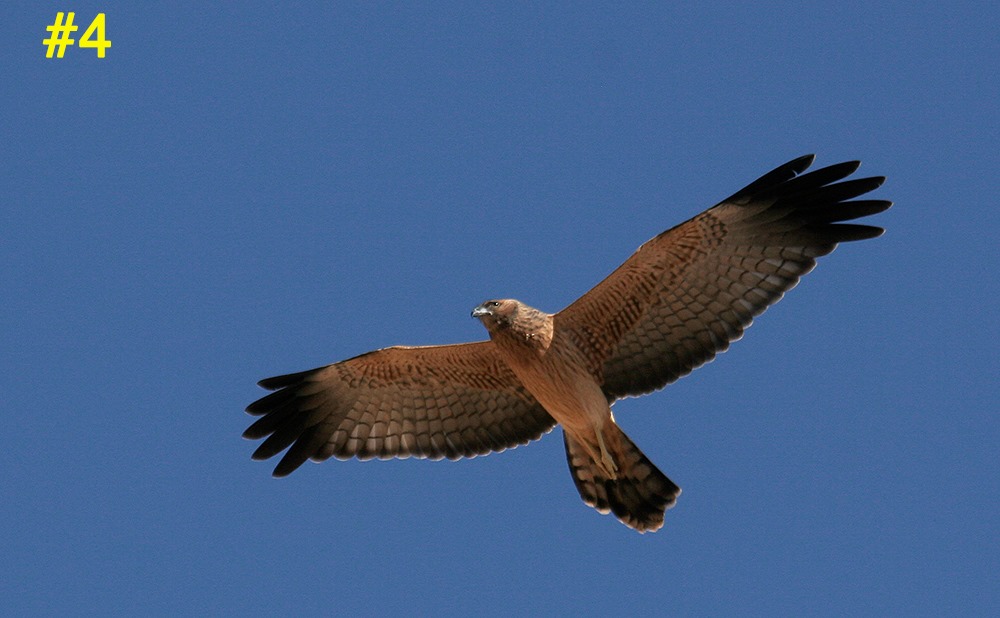
The low-soaring, passing over the countryside, behaviour of this bird really helps to ID it. This is a Spotted Harrier.
Gizz — As mentioned, harriers are likely to be flying low over the brush when they’re hunting. They tend to pass several times over a specific area. They are slow soaring fliers, and rock a bit as they fly, with their wings upswept as described with bird #2. This behaviour is one of the key features to look for when IDing a harrier. Spotted Harriers tend to be found over drier country and Swamp Harriers over wetter — but this is definately not an ID feature, as I’ve seen them swap habitats occasionally.
Shape — Shape can help you confirm that you have a harrier, but doesn’t help distinguish between the two species. Compared to most of the birds seen so far, the wings of the harriers tend to be a bit shorter and broader, but still fingered. One difference to look for is that harriers have only five fingers, rather than the six that the kites and eagles have. But be careful if your bird is in moult! Another key feature is the “owl-like” face of the two harrier species. Both harrier species also have a rounded tail, slightly shorter than their body but not much.
Colour — This is how you distinguish between the two species of Harrier once you’ve narrowed it down by shape. If you get a good look at the top of the bird, the Swamp Harrier can be immediately discovered by its bright white rump, while Spotted has a dark rump. But it’s a bit more difficult from below. Both can have a banded tail, but the adult Spotted Harriers have the strongest banding. You can see the banding in this bird’s tail. The dark tips to the primaries and strong dark trailing edge to the wings are a great indicator that you have a Spotted Harrier (as seen here), as this is much less pronounced in Swamp Harriers. If you can look closely enough, you’ll also see the “spotting” in the body feathers of the Spotted Harrier as opposed to streaking in a Swamp Harrier.
Compare the wing shape here to the kites, particularly the Square-tailed Kite in #3.
Bird of Prey #5
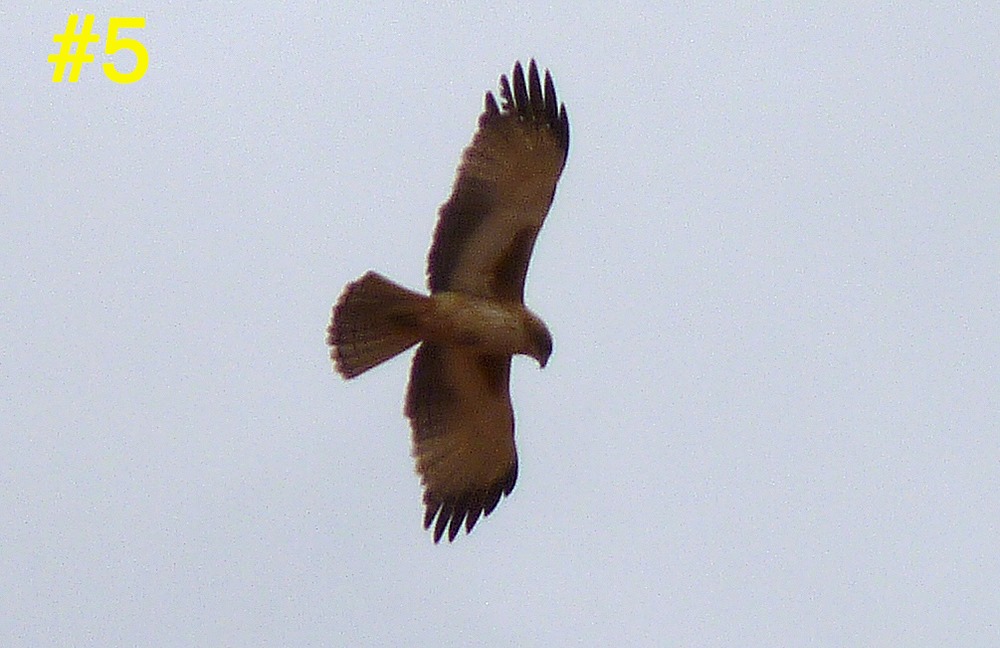
As briefly mentioned under the ID for bird #1, this is a Little Eagle – light morph.
Gizz — Little Eagles are much more compact than the other birds of prey and soar with their wings level rather than upswept. They have a stable flight and are generally found around lightly wooded habitats. They soar in tighter circles than other raptors, and will often swoop or dive while soaring.
Shape — These birds have shorter wings and a more compact body, with a moderate length tail. Like the harriers, they only have five distinct “fingers” on their wings. Their tail is slightly rounded but can look square when pulled tightly together. They have a very large head ratio relative to the birds seen so far, with not much neck, making them look short and stubby. Their feathers, as with other eagles, go all the way to their feet.
Colour — There are two colour morphs of Little Eagle. The light morph, seen here, is relatively easy to ID with a distinctive M pattern under it’s wings. The M is not just from pale shoulders, like in the Whistling Kite, but actually drops down toward the middle of the wing where it hits the bird’s body. The dark morph is harder to tell. They only have a pale patch in the inner primaries and are darker all over. Body shape is best for IDing Little Eagle, then look to see which of the two colour morphs.
Compare the underwing pattern to the Whistling Kite in #1. Also compare the general shape and tail/wing shape to the dark morph Little Eagle in #9.
Bird of Prey #6
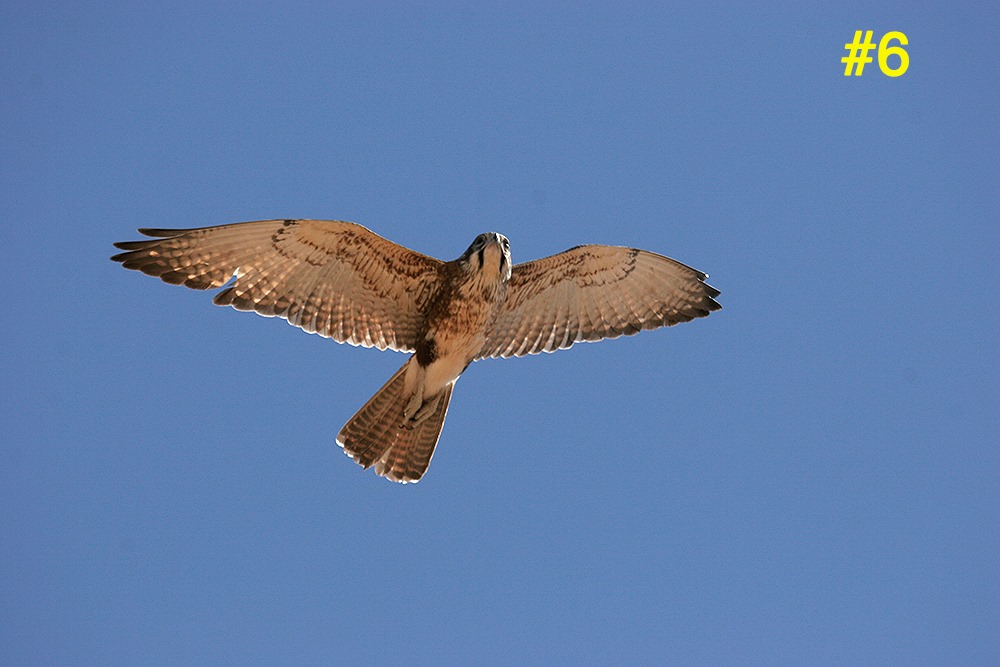
This is the only bird here that’s in a different group from the other raptors – with falcons being more closely related to parrots than they are to the other birds of prey. This is a Brown Falcon.
Gizz – When we think of falcons we tend to think of fast-flying bird hunters, but the Brown Falcon is not one of these. It’s rare to get a flight shot like this, as Brown Falcons tend to be spotted sitting on top of their favourite perch watching the ground below. They are pretty specialised reptile hunters — with very long scaly legs that protect them from lizard and snake bites. They are comfortable on a perch or on the ground. However, I’ve occasionally seen them facing into a stiff breeze and “soaring” by using the breeze to keep them up. I’ve never seen this behaviour on a calm day.
Shape – Falcons can be distinguished from the other raptor groups by their thin blade-shaped wings with pointed tips — no fingers here! Brown Falcons are again a bit odd, as their wings tend to be a bit broader and come to a less defined point than the other falcons, but you can still see the difference between these and the other brown raptors here. Brown Falcons have a relatively long and slightly curved tail.
Colour – Brown Falcons are notorious for having many different colour morphs. You can usually see the banding in the wings and tail, though it’s more pronounced in certain colour morphs. This is a relatively pale morph brown falcon. To distinguish from the other falcons, look for the double teardrop (dark marks below the eye both in front and behind), and also the brown “trousers” — dark brown feathers at the tops of the legs. These two characteristics are present in all the morphs.
Bird of Prey #7
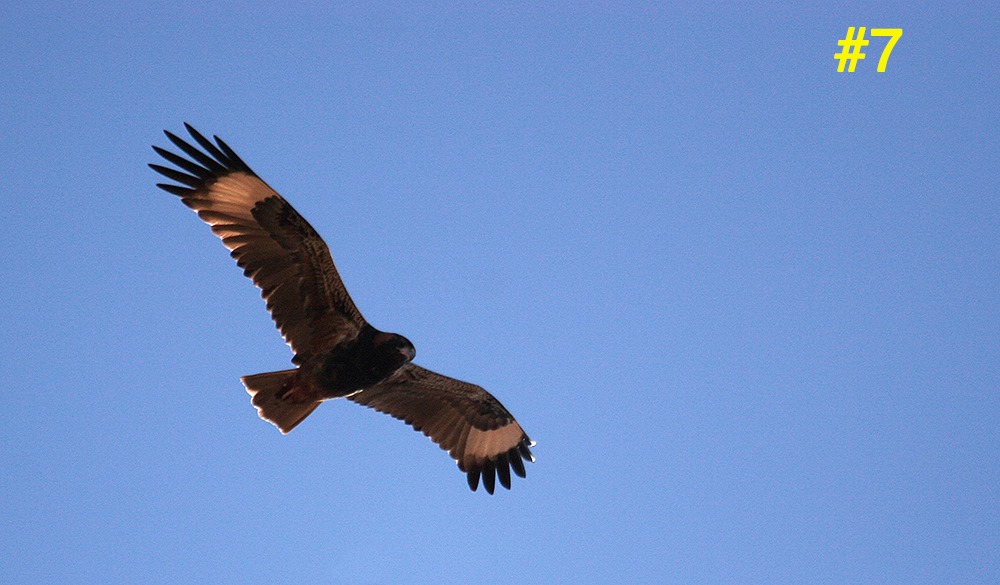
One of my favourite birds, this is a Black-breasted Buzzard.
Gizz — This is another that flies with upswept wings, and really rocks back and forth as it flies. They fly very slowly, soaring on thermals coming of the roads or rocky outcrops. They are pretty good nest raiders, and are the only bird able to break into an emu egg (using a rock as a tool!), but you can also find them on roadkill. A real inland/arid zone specialist, so not likely to be spotted on the coast!
Shape — Long, upswept wings with long fingers (six of them), and very long wings compared to their relatively stubby body. They also have a very short tail, half their body length or less. The stubby tail allows them to walk around comfortably on the ground whether scavenging, or hunting for emu eggs. The short tail is key!
Colour — The white “window” at the end of the wings is key to IDing this species. It’s present in all ages, but much more noticeable in the adults, which have a darker body colour overall, including the black breast that they’re named after. The white patch is further out on the wings than in the Whistling Kite, being actually made from two tone colour in the outer primaries. This also means the white patch is visible from both above and below, like a “window”.
The most common misidentification is with Whistling Kites being mis-ID’d as a BBB — but have a look at the tail ratio! And also the location of the white patch.
Bird of Prey #8
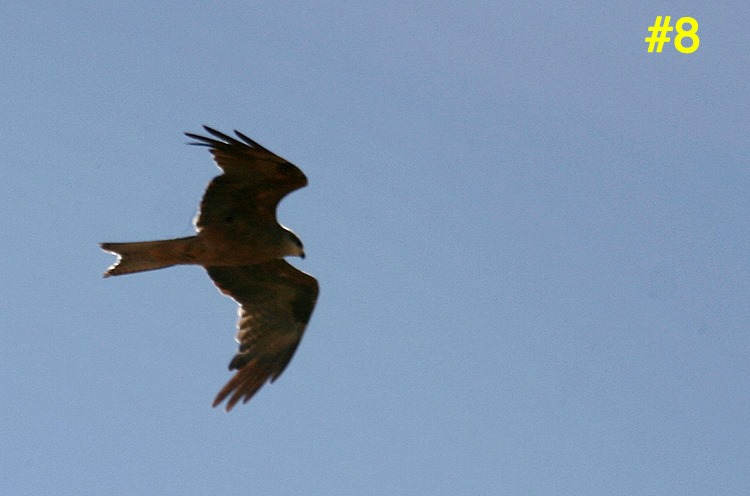
A lot of you got this one, too. This is a Black Kite.
Gizz — These birds are often found in large flocks, the only raptor that forms these big flocks. They are commonly found circling in the smoke from bush fires and are sometimes called “fire kites” and sometimes can be found with Whistling Kites. They’re great scavengers, and also gather in large numbers around rubbish tips and towns. Sometimes also called the “Kimberly Seagull” as they love to steal from people too.
Shape — Tail shape can be key to IDing this bird. Like the other kites and the eagles, this is a soaring bird with long, broad and fingered wings (six fingers). But the real key is in the tail shape. The Black Kite is the only bird of prey in Australia that has a fork-shaped tail (out to two points with a dent in the middle). You do have to be careful with birds in moult, which might look “forked” because of missing feathers, but the Black Kite will have a nice smooth look to it’s fork, with the inner tail feathers much shorter than the outer. When they spread their tail to use it as a rudder, it can sometimes look a bit straighter on the end, in a bit of a triangle behind them – but you should still be able to tell that the inner feathers are much shorter than the outer, and that it would resemble a fork if it were pulled back together. When they’re soaring high in the air or perched, Black Kite pull their tail together, which shows the fork.
Colour — Black Kites are not actually black, but are dark brown. They can have some pale barring present, but the shape of the bird is the best indication for this bird. If you get a close look at the face, you’ll be able to see that they have a yellow cere, which can help distinguish them from Whistling Kites if you can’t see the tail.
Bird of Prey #9
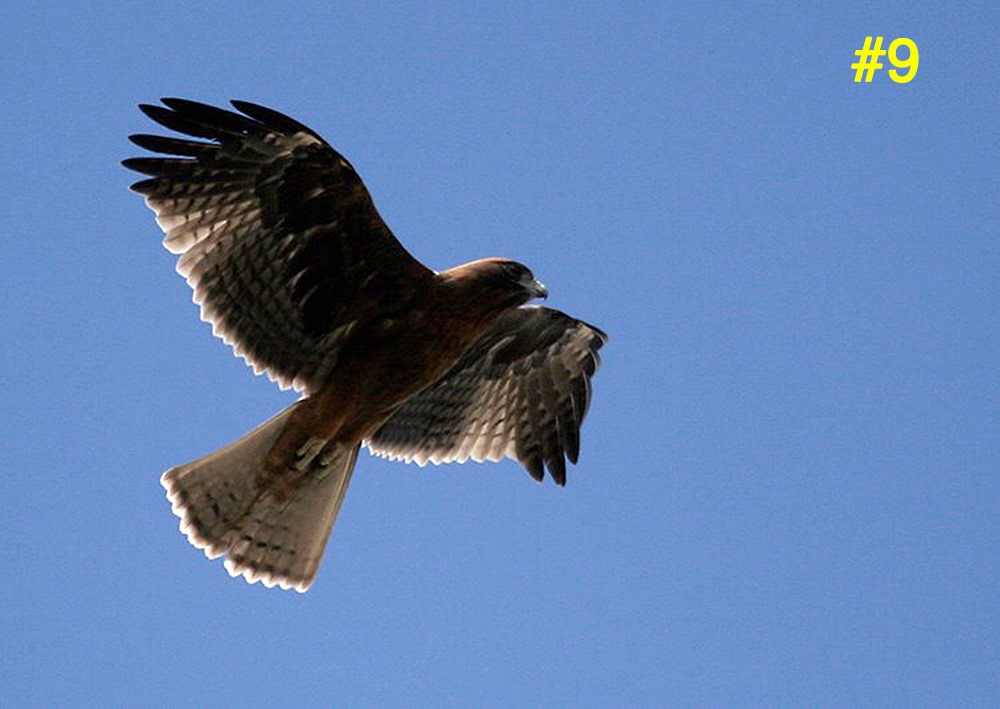
This is a bit of a tricky one (and a bit unfair as we’ve already had one of these). This is a Little Eagle – dark morph.
Gizz — Little Eagles are much more compact than the other birds of prey and soar with their wings level rather than upswept. They have a stable flight and are generally found around lightly wooded habitats. They soar in tighter circles than other raptors, and will often swoop or dive while soaring.
Shape — These birds have shorter wings and a more compact body, with a moderate length tail. Like the harriers, they only have five distinct “fingers” on their wings. Their tail is slightly rounded but can look square when pulled tightly together. They have a very large head ratio relative to the birds seen so far, with not much neck, making them look short and stubby. Their feathers, as with other eagles, go all the way to their feet.
Colour — There are two colour morphs of Little Eagle. The light morph is relatively easy to ID with a distinctive M pattern under it’s wings. The M is not just from pale shoulders, like in the Whistling Kite, but actually drops down toward the middle of the wing where it hits the bird’s body. The dark morph, seen here, is harder to tell. They only have a pale patch in the inner primaries and are darker all over. Body shape is best for IDing Little Eagle, then look to see which of the two colour morphs.
Compare the underwing pattern to the Whistling Kite in #1. Also compare the general shape and tail/wing shape to the light morph Little Eagle in #5.
Bird of Prey #10
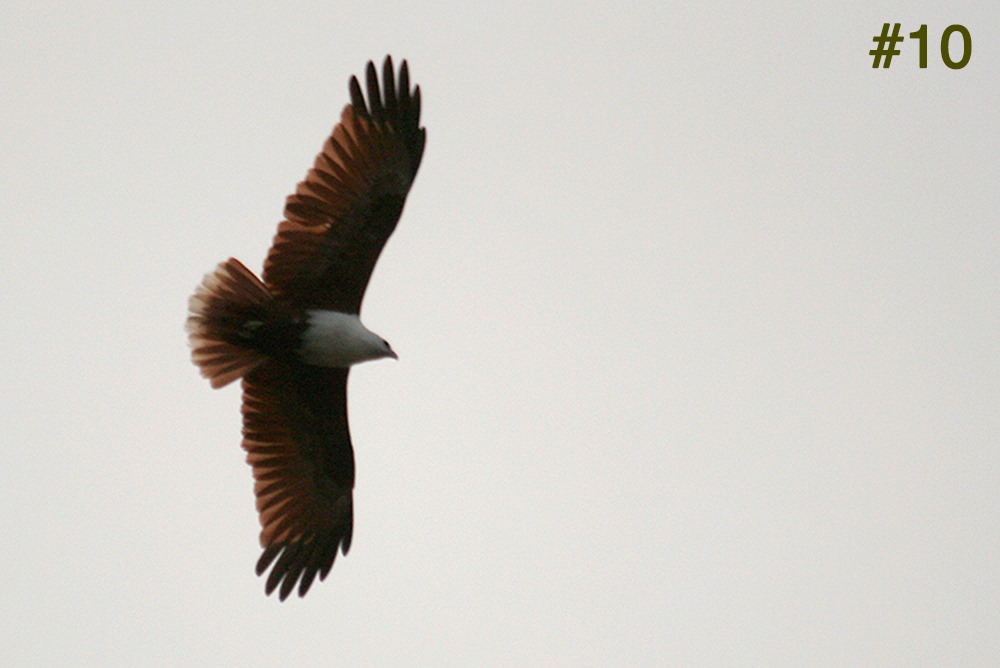
A number of you got this one, too. One of the few where the distinctive colour pattern is good for an ID, but it’s good to look at the other features, as the immature birds don’t have the easy colour pattern. This is an adult Brahminy Kite.
Look for the rufous brown feathering and bright white head and chest to ID the adults. This is a northern coastal bird, and not found inland or in the southern areas of Australia. 🙂
Bonus image of the juvenile Brahminy Kite , along with a description of how to ID from Whistling Kite.
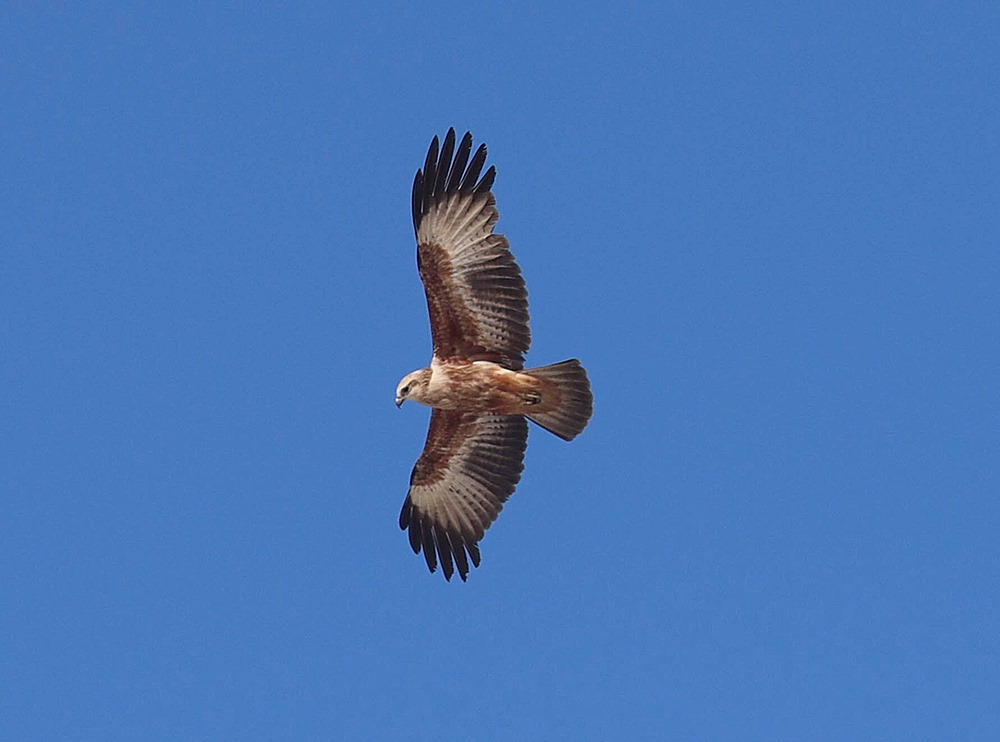
… Jannette Manins very kindly provided this image her husband Peter snapped of a juvenile Brahminy Kite. This was taken at Teewah Beach, Great Sandy NP last July.
Notice the similarity to the Whistling Kite! And the immature birds can be even harder to distinguish, as they lose a bit of the dark chest.
A few key features to note:
Tail length. Brahminy Kites have a tail around half the length of their body or slightly longer. It is rounded like a Whistling Kite, but the Whistling Kite tail is as long as their body.
Wing shape. Another thing to look at is the shape of the wings, which are shorter and broader. Overall, this makes the Brahminy Kite look “stubby” compared with a Whistling Kite.
Underwing coverts. The coverts (basically the feathers covering the “arm” of the bird, above the flight feathers) on a Brahminy Kite are brown/rusty in colour, whereas this tends to be paler on a Whistling Kite.
Also, note some key similarities with the Little Eagle — but look out for those feathered legs.
Hope this helps if you’re ever up in the Top End and spot a kite near the coast!
 Women Birders Australia