L Plater ID CHALLENGE on Women Birders Australia 22 June 2020 by Janine Duffy
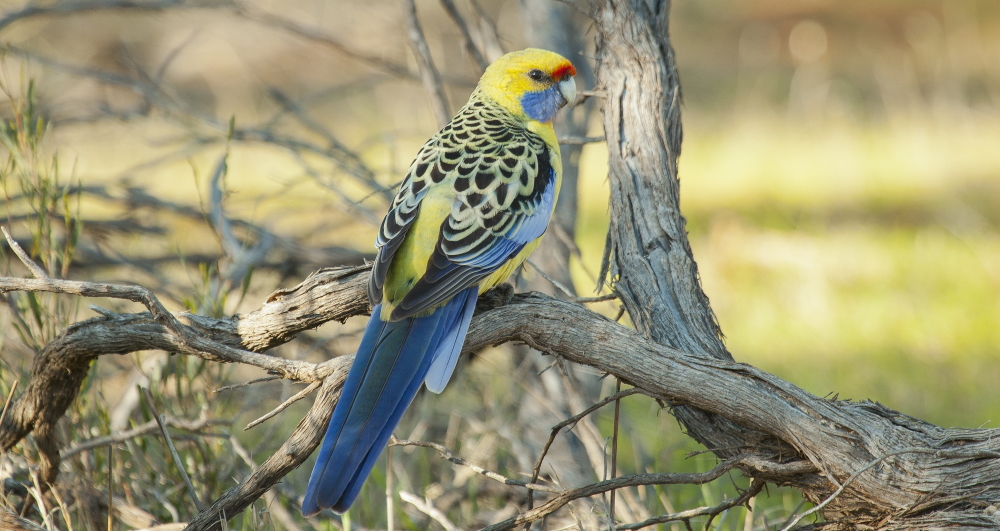
Who is this lovely bird? Seen around the river forests of Wentworth-Mildura on the border of NSW & Vic.
Size: medium for this sort of bird. Behaviour: foraging both on the ground and in the canopy.
Also there’s some very interesting things about this ‘version’ of the species. Please tell us!
Pic by Michael Williams It’s A Wildlife Photography
Solution:
Yellow Rosella Platycercus elegans flaveolus
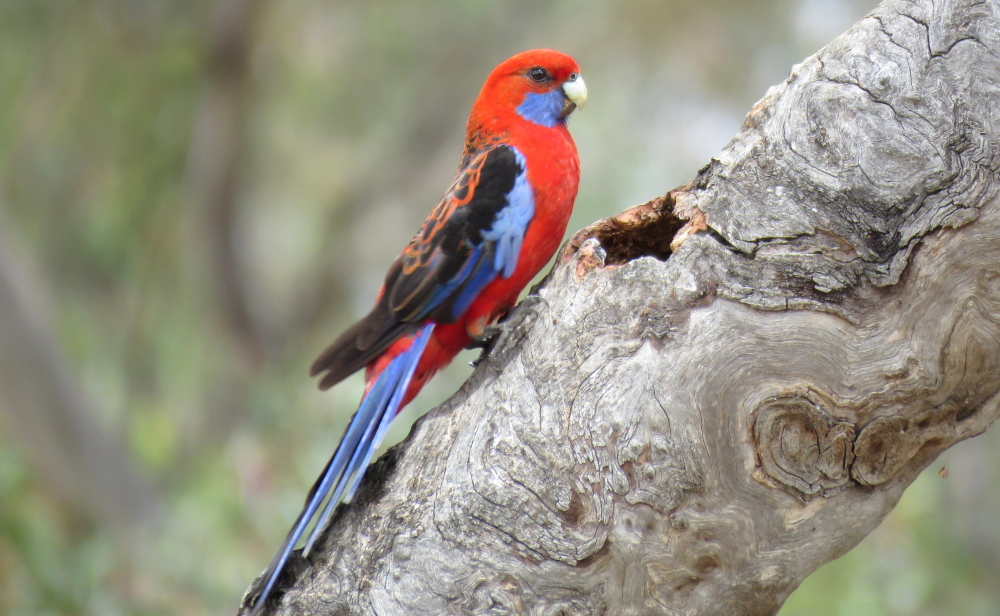
The blue cheek on this bird is diagnostic on the mainland – all forms of the Crimson Rosella have the blue cheek, and no other mainland rosellas do. (The Tas Green Rosella does too, but it’s only in Tas)
The location and the basic body plumage colour identify this bird as a Yellow Rosella – one of six subspecies in the Crimson Rosella complex.
As for the interesting facts about this subspecies – have you ever wondered why the Crimson-Yellow-Adelaide Rosellas have so much colour variation across their range? Other parrots with similar ranges don’t have such huge variability. Aust Ringneck complex is the closest – it has some variation in the head or belly colour, but it’s range is much larger and the basic body colour barely changes. Red-rumped Parrots have a much larger range than (and overlap) Crimson Rosellas, and have almost no colour variation except for a slight paleness of the most inland birds (see Gloger’s Rule).
Well, you’re not alone. There have been multiple studies & theories on colour variation in Crimson Rosellas.
One studied their eyes, in particular their colour vision, to find out if the way they see colour differs within the species. No conclusion was drawn. Link.
Another studied the virus Psittacine Beak & Feather disease (PBFD/V) and found that hybrids with a parent from different subspecies had lower levels of the virus, and that the intermediate forms (Orange & Adelaide) also suffered less from PBFV. Link
Most recently, a study showed that temperature, humidity and sun reflectance affected the colouring. Yellow Rosellas lived in areas where the temperature and sun reflectance were high and the humidity low, and Crimson Rosellas lived in the opposite environments. This is similar to, but more complex than Gloger’s Rule.
Read about it in this excellent article by WBA member Tanya Loos.
The theories that have been used to explain this difference in colour are also very interesting for birders.
First there’s the theory of Ring Speciation: the idea that a species radiates out from a starting point, and small changes occur in subpopulations. The subpopulations closest to reach other can interbreed, but if those subspecies at the far end meet up, they are too different to interbreed.
However, Ring Speciation is not supported in the case of Crimson Rosellas.
The other theory is Gloger’s Rule: the idea that within a species animals are darker & redder in warm humid places and lighter & greyer in cold dry places. Warm dry places favour light reddish animals, and cold humid places make a bird more dark brown.
Once again, Gloger’s Rule does not fully explain the variation in Crimson Rosellas.
Can you think of an example of Gloger’s Rule in Australian birds?
 Women Birders Australia