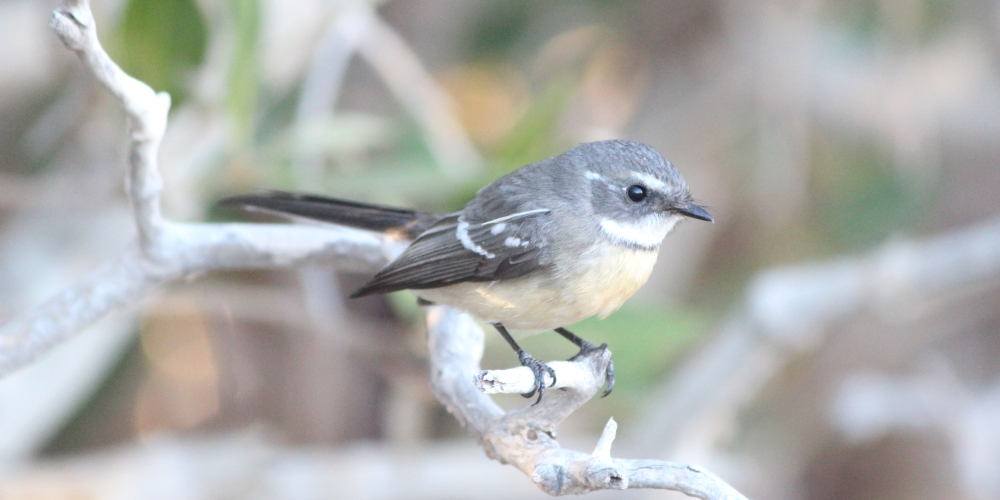
This advanced identification challenge appeared on Women Birders Australia on 16 April 2020.
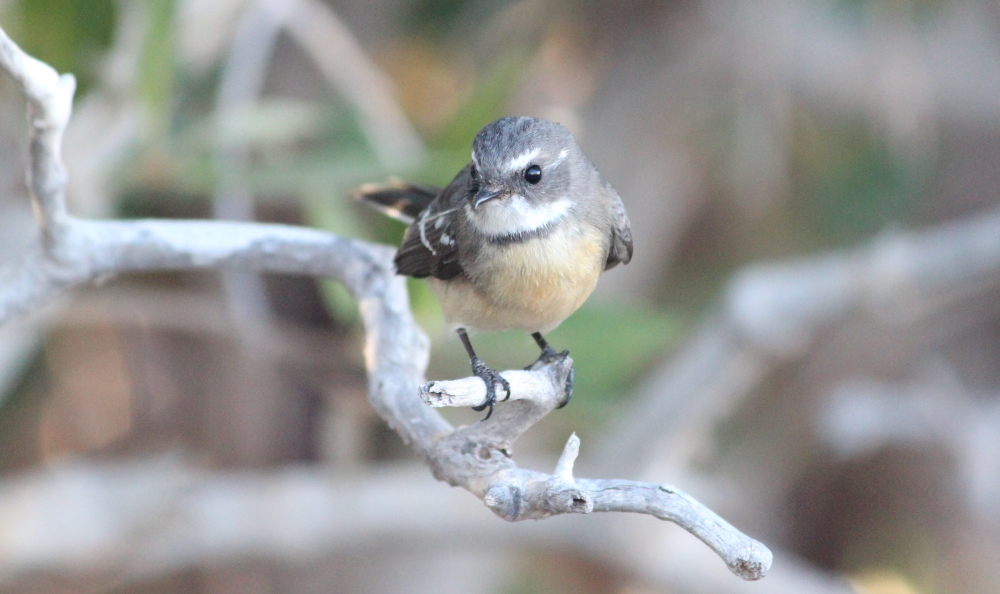
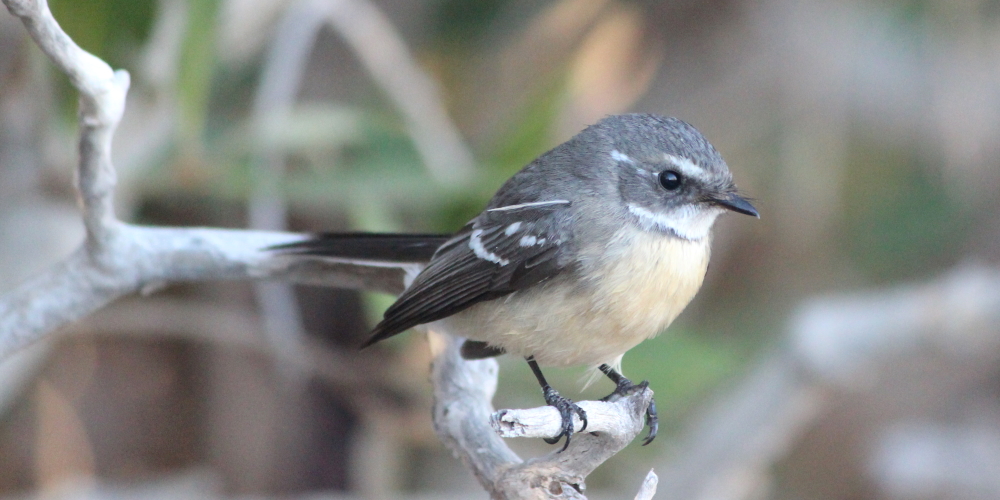
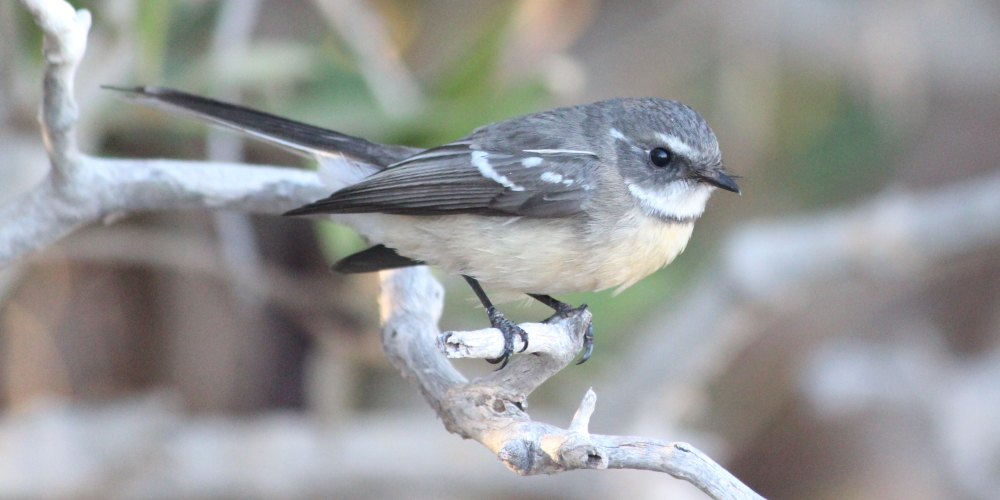
The bird is clearly a fantail, with the long tail and posture typical of the rhipidura genus.
Location:
The location was given as near Exmouth, WA. In that area there could be potentially two species of fantail: Grey Fantail Rhipidura albiscarpa and Mangrove Grey Fantail Rhipidura phasiana. But its not that simple – Grey Fantail has several subspecies throughout Australia, all with subtly different plumage, and two that could potentially be in that area.
According to the Australian Bird Guide – ABG (Menkhorst et al), ssp preissi lives around the south west of WA, but appears to go north into the Pilbara region at times. Ssp albicauda of inland Australia does not appear to extend west to the coast, but Birds of the Greater Southwest (Nevill) shows albicauda in this region and states that albicauda “is nomadic, moving where weather conditions are favourable, but may be sedentary in the Pilbara. Albicauda possibly does not reach the far west coast south of Carnarvon” (Exmouth is north of Carnarvon)
Neville goes on to say that “particularly in winter, the Grey Fantail ssp preissi can move through the coastal mulga belt but rarely feeds in mangroves.”
So based on location it could still be one of two species + 2 subspecies.
Plumage:
Grey Fantail ssp. preissii (similar to alisteri – pics in ABG): grey above, darker on head, wings and uppertail, short thick white supercilium, whitish throat with narrow black breast band (sometimes reduced or absent), underparts off-white to buff-white.
Looking at photographs, ssp preissi does seem to have some grey shading under the breast band – a feature that was noticed lacking in this bird by Jannette Manins.
See ssp preissi on eBird: https://ebird.org/media/catalog?taxonCode=gryfan7&mediaType=p&sort=rating_rank_desc&q=Grey%20Fantail%20(preissi)%20-%20Rhipidura%20albiscapa%20preissi
Grey Fantail ssp. albicauda is said to be paler than other ssp in ABG, but darker in Nevill. Main difference is extent of white in tail, but these pics do not show tail well. Pics on eBird show a darker upperbody with a lot of contrast against the very pale underside, and a very grey-shaded breast, sometimes even spotted. Pizzey shows albicauda as paler than SE race alisteri, with dark shading around lores, eye & cheek and broad black breast-band.
See ssp albicauda on eBird: https://ebird.org/media/catalog?taxonCode=gryfan8&mediaType=p&sort=rating_rank_desc&q=Grey%20Fantail%20(albicauda)%20-%20Rhipidura%20albiscapa%20albicauda
Mangrove Grey Fantail, however, is noted as very like Grey Fantail but smaller and paler. ABG states it “differs from Grey Fantail ssp albicauda and preissi (which occasionally extend into range of Mangrove Grey) by much paler grey upperparts, narrower, paler grey breast-band and smaller size with shorter tail.
Nevill says it has the palest upperbody and a pale, very narrow chest band. Pizzey mentions a longer bill, large white supercilium, paler brownish-grey upperparts.
I have noticed in pictures that there is very little dark shading around the eye and lores in Mangrove Grey Fantail, but rather the grey colour is the same as the rest of the head. But this is not mentioned in any of these field guides.
Mangrove Grey Fantail on eBird: https://ebird.org/media/catalog?taxonCode=manfan1&mediaType=p&sort=rating_rank_desc&q=Mangrove%20Grey%20Fantail%20-%20Rhipidura%20phasiana
From a plumage point of view, this bird has a very narrow chest band, pale grey upperparts, buffy underparts and a very narrow chest band. All these strongly suggest Mangrove Grey Fantail Rhipidura phasiana.
Habitat:
This little bird was seen amongst mangroves at the Mangrove Bay Bird Hide in Cape Range NP near Exmouth, WA in April 2019. It stayed for some time, feeding, and looking very much at home. I didn’t say that in the original post, as being in a mangrove is the biggest hint of all – it would be very unlikely to see a Grey Fantail feeding and hanging around in this habitat.
..
NOTES & REFERENCES:
Menkhorst, Rogers, Clarke, Davies, Marsack, Franklin (2017) The Australian Bird Guide (ABG) , https://www.publish.csiro.au/book/6520/
Nevill Simon J (2008) Birds of the Greater South West
Pizzey & Knight (2000) The Field Guide to the Birds of Australia.
 Women Birders Australia