January 3, 2020:
Author: Janine Duffy
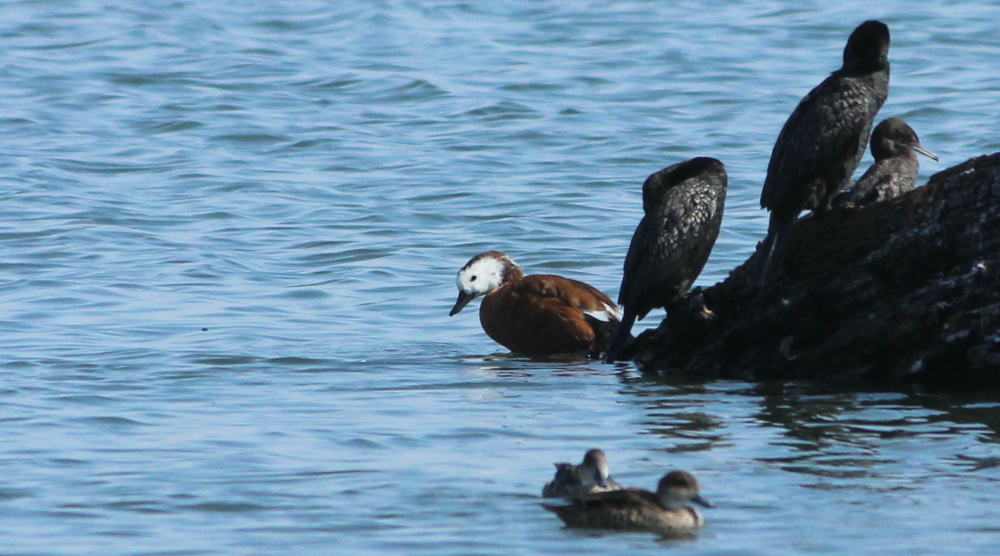
Exciting times at Western Treatment Plant (WTP), Victoria Australia. A vagrant shelduck with a white head has appeared. She is gorgeous.
This shelduck arrived at the Western Treatment Plant, near Melbourne Victoria, on or before 1 Jan, 2020. She was first reported by Andrew Allen in the morning. Many birders showed up to see her and take photographs.
She was quickly called ‘Amy Paradise’ due to a typo by one commenter on facebook.
She has a mostly white head with dark crown and neck. The dark neck on her right side extends onto her cheek. She was first assumed to be a juvenile female Paradise Shelduck from New Zealand.
She is in moult and has lost all her wing primary feathers.
But other experienced birders were saying that she can’t be a juvenile, and be moulting all her primary feathers, because only adults do that.
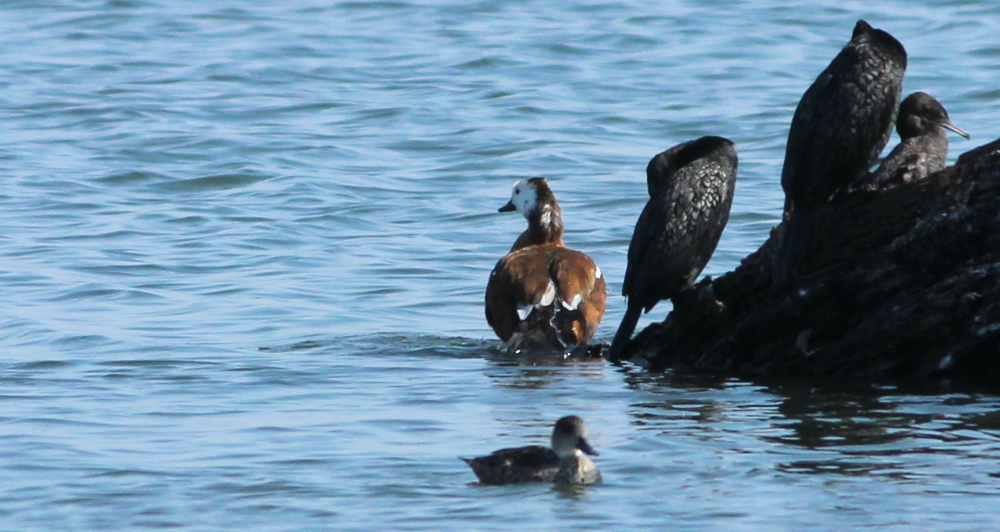
So, reading up on it I discovered:
Waterfowl have a complete ‘simultaneous wing moult’ where they lose all their primary feathers at the same time. They are flightless for 20 – 40 days. (1) In shelducks, at least, this occurs after breeding.
A female Paradise Shelduck moulting her wing feathers should have adult plumage = all white head. So maybe she is a South African Shelduck adult female.
If so, she is a long way from home.
Overseas, many ducks, particularly shelducks, will fly a long way to go to a good place to moult – a wetland with lots of food and safety for them in this dangerous, high energy time. (Growing new feathers requires lots of high protein food). South African Shelducks are known to fly a long way. Paradise Shelducks tend to stay in NZ.
..
A summary of the two species – South African vs Paradise Shelduck:
South African Shelduck
Tadorna cana
- Lives and breeds in South Africa & Namibia. Known to undertake long flights to moulting grounds.
- Breeds July to October
- Full wing moult after breeding from October to February (2).
Great info here: https://www.hbw.com/species/south-african-shelduck-tadorna-cana#Breeding
See pics of female South African Shelduck here: https://ebird.org/australia/species/soashe1
Paradise Shelduck
Tadorna variegata
- Lives and breeds in New Zealand. Fly to moulting sites, but short distances, within New Zealand.
- Breeds August to October
- Full wing moult (adults & 13 – 18month old immatures) after breeding January to February, or as early as December in pre-breeding immatures and failed breeders.
- Adult female plumage achieved in first year.
- Juvenile female head plumage: starts dark, white feathers spreadin backwards from bill.
- Immature female head plumage: White head, but few grey-black ear covert feathers persist. This plumage lost 6 months after fledging.
Great info here: http://nzbirdsonline.org.nz/sites/all/files/018_Paradise%20Shelduck.pdf
See great pics of female and immature Paradise Shelduck here: https://ebird.org/australia/species/parshe1
Update: Rohan Clarke has made these comments about the bird (from Australian Twitchers facebook page):
“I dropped in and saw this bird on the way past WTP on 1st Jan. I think it is most probably a mutant Australian Shelduck but I am having trouble ruling out Cape Shelduck.
Firstly, there was a bird looking almost identical to this at the same site back in March 2013. I recall there was a good email discussion about that bird but couldn’t find those emails the other night. Jen Spry has now posted pics from 2013 in this thread. Noting that photos show a white head with dark nape and hindneck and a dark intrusion onto the cheeks and a distinctly rufous body both in 2013 and 2020 the odds that these two sightings represent two different individuals seems remote.
On plumage alone, it isn’t a juvenile female Paradise Shelduck transitioning to adult plumage because a) the dark markings on the head are too uniform and well defined (nape, hind neck and cheeks) without any mottled dark feathering suggesting it is transitioning, b), the body is richly rufous when a juvenile female transitioning to adult plumage should still show many (mostly?) male/juv-like dark sooty grey feathers to the upperparts and c) Paradise Shelduck retain primaries for 12-15 months after fledging but moult body and tail feathers just 2-3 months after fledging…that is female Paradise shelduck start showing a white head at 2-3 months but first replace flight feathers 12 months later…by which time the head is fully white. Finally, if you accept that it is the same bird as photographed in 2013 then obviously it can’t be a 7 or 8 year old juvenile!
It isn’t a bad fit for a female Cape Shelduck. Most female Cape Shelduck show a more extensively dark crown, nape, hindneck and cheeks (ie they have a white face) but some (presumably older birds) show more extensive white heads that are a close match to this bird. Underparts look good, including those undertail coverts, uppertail looks OK, as does the tone of the upperparts. My main problem with Cape Shelduck is there is really no precedent for Southern African vagrant landbirds/waterbirds occurring in Australia. Best I am aware of is Lesser Moorhen on Cocos Keeling (still ~2000 km west of Australia) and an Elephant bird egg on the WA coast (that one wasn’t twitchable). There are also no Cape Shelduck kept in captivity (at least legally, and illegal captive birds are pretty scarce in Australia although there are some proven exceptions). Sure, birds fly, and get ship assisted etc but it is ~7600 km between Southern Africa and Western Australia and recent history has shown that to be a very real barrier.
So if not a true vagrant then other possibilities are that it is a mutant Australian Shelduck that just happens to look like a Cape Shelduck…and I don’t think this is a totally implausible, especially if Cape/Ruddy Shelduck is the ancestral-type for southern hemisphere shelducks because we might then expect the very occasional mutation to look like ancestral stock.
When it finishes it’s moult it will be interesting to see what it looks like through I’m not sure that will change the debate much as Cape Shelduck and Australian Shelduck should show the same wing pattern.
My potted summary that it is a good one to see for ‘insurance purposes’ but I’m not ticking it at the moment. For it to be a Cape Shelduck I reckon it needs to be a PERFECT fit when it has finished it’s moult in a few more weeks, otherwise I’m in the mutant camp
..
NOTES & REFERENCES:
(2) https://www.tandfonline.com/doi/abs/10.1080/00306525.1978.9632634?journalCode=tost20
 Women Birders Australia